

Philipp Marx
Founder of RattleStork
Philipp Marx is a founder of RattleStork and a former international sperm donor. He writes from first-hand experience about sperm donation, co-parenting, and alternative paths to parenthood.
Before founding RattleStork, Philipp donated sperm in several countries. That experience showed him how differently people approach donor conception, trust, personal boundaries, and co-parenting.
At RattleStork, he combines that perspective with publicly available sources and practical guidance for donors, recipients, and prospective co-parents. His personal experience is not a substitute for medical or legal advice.
Articles by this author
Total published articles:220

Consent in Everyday Life: What Agreement, Pressure, and Boundaries Really Look Like
Consent is more than a yes or a no.
Different libido in a relationship: what couples can do about mismatched desire
Different libido is common in relationships and does not on its own tell you anything about love, attraction, or the worth of the relationship.
Sex under trying-to-conceive pressure: how timing, expectations, and goal mode can wear down intimacy
When sex in the trying-to-conceive process becomes all fertile days, tests, and hope, it loses its ease quickly.
Ghosting when trying for a baby: when a contact suddenly disappears
If a contact vanishes while you're trying for a baby, it is not just disappointment.
Fertility Budget: Planning Treatment, Extra Costs, and a Realistic Buffer
A fertility budget only works when diagnostics, treatment, medicine, travel, and a proper buffer are planned together.
Donor siblings and DNA tests: what families should keep in mind early
Donor siblings are genetically related children who grow up in different families.
Carrier screening before sperm donation: when genetic testing is worth doing
Carrier screening, or carrier testing, can be worth doing before sperm donation, but only when the question is clear.
Sexting, Nudes and Privacy: the Practical Guide to Consent, Passing On, and Digital Traces
For many people, sexting is already part of dating, relationships and casual intimacy.
Aftercare After Sex: Why Closeness, Calm, and Real Connection Matter
Good sex does not end with orgasm.
How soon can you get pregnant after giving birth?
Fertility can return before the first period. This guide explains timing, breastfeeding patterns, LAM, pregnancy tests, contraception, and trying for another baby.
Contraception After Birth: Which Methods Are Realistic and When
After birth, the body does not settle back into its old rhythm straight away.
Late period but not pregnant? Common reasons and when to see a GP
If your period is late, pregnancy is the first thing many people think about.
Can you get pregnant if you wee straight after sex?
Short answer: no.
Can stress push ovulation back?
Stress is not a simple switch, but it can measurably delay a cycle or make it less predictable.
Can pregnancy happen without penetration?
Yes, but only if fresh sperm or semen-containing fluid actually reaches the vulva or the vagina.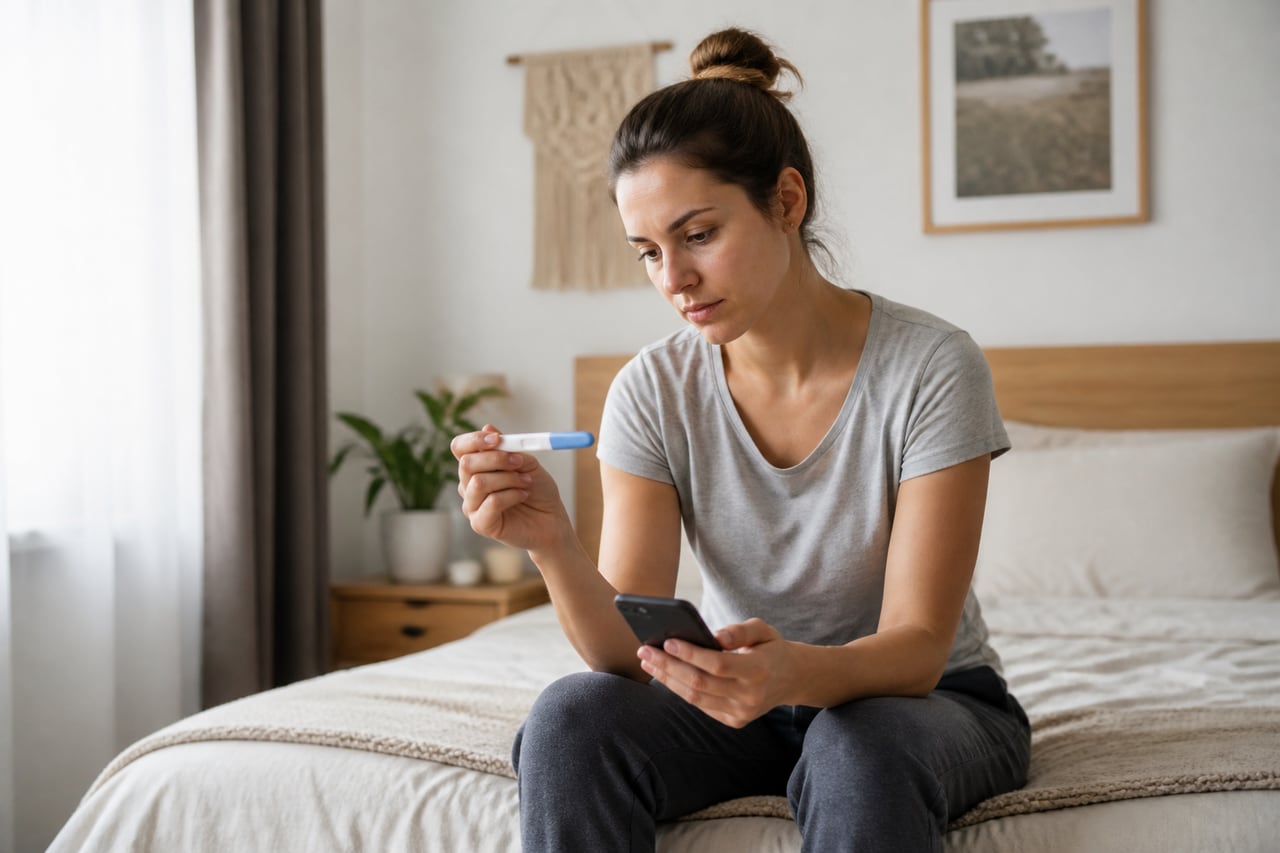
Pregnant after what seemed like a period? Understanding bleeding in pregnancy
You cannot have a true period during pregnancy, but you can bleed. What matters is the pattern, accompanying symptoms and medical assessment.
Spotting before your period: what it can mean and when to seek help
Spotting before your period usually means only a small amount of blood, but there can be quite a few different reasons for it.
Fertility, Chance, and Hope When Trying for a Baby: What Your Chances Really Mean
When people talk about fertility, chance, and hope when trying for a baby, three different layers often get compressed into one sentence.
Pregnancy spacing after birth: why the gap matters medically
The gap between one birth and the next pregnancy is not just a family-planning choice.
Pubic Hair Removal and Pubic Hair: Sexual Satisfaction, Body Image and the Real Risks
Pubic hair removal is common and is often linked to cleanliness, attractiveness, or partner preferences.
Low Sexual Desire and Alexithymia: Is There a Link?
Alexithymia mainly describes difficulty recognising feelings, putting them into words, and distinguishing them from bodily signals.
Vaginal depth during arousal: what changes and what does not
Yes, sexual arousal changes the vagina functionally.