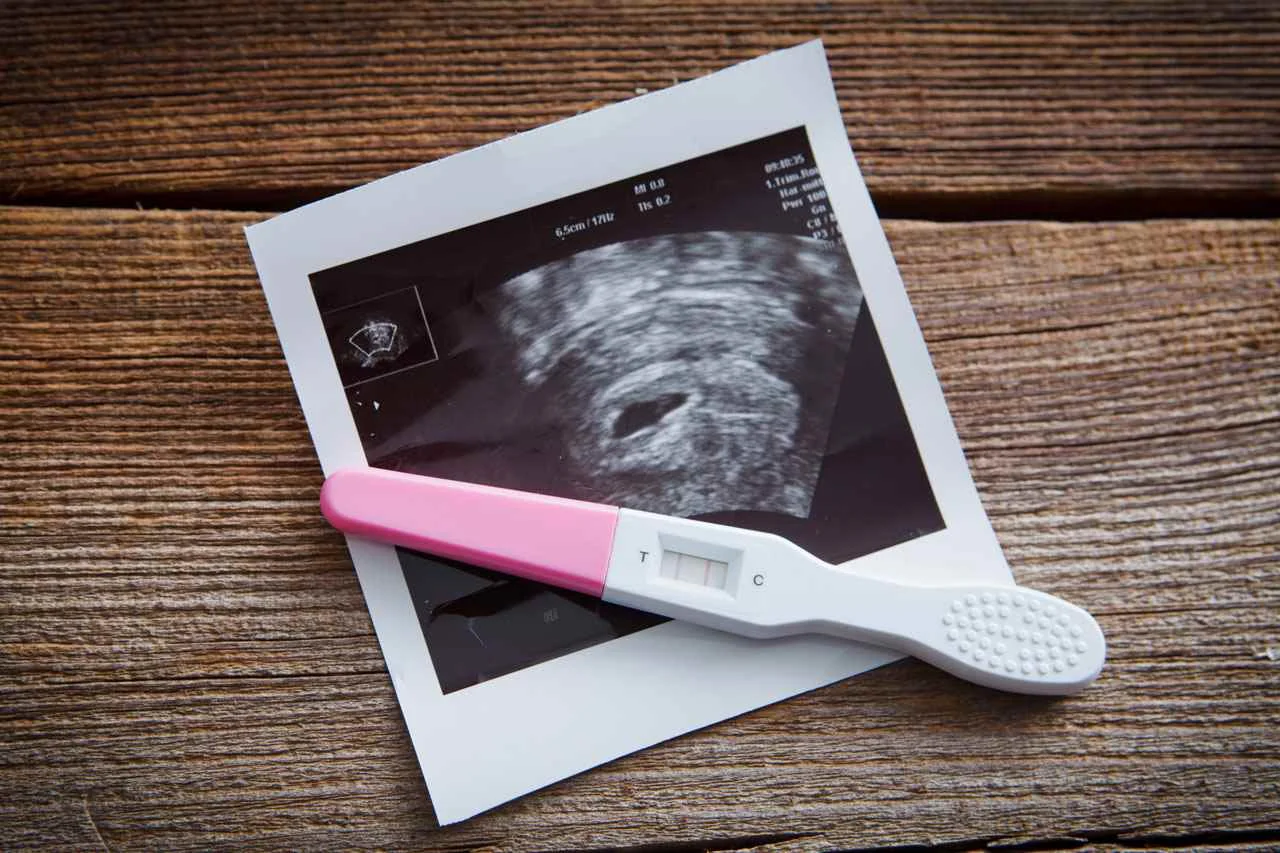
Pregnant after what seemed like a period? Understanding bleeding in pregnancy
A true menstrual period cannot happen during an ongoing pregnancy. Bleeding can still occur and may even resemble a period. This guide explains possible causes, pregnancy tests, ultrasound scans and warning signs without pretending that colour or amount can provide a diagnosis at home.


The answer in 60 seconds
A true menstrual period and an ongoing pregnancy cannot occur at the same time. You can, however, be pregnant and bleed from the vagina, sometimes around the date you expected a period. The cause may be a harmless cervical change, but it may also be an early pregnancy loss, an ectopic pregnancy, or, later in pregnancy, a placental problem.
- Tell your GP, midwife, early pregnancy unit or maternity team about any bleeding during pregnancy.
- Colour and amount provide useful clues but cannot diagnose the cause.
- A positive test does not confirm where the pregnancy is or whether it is developing normally.
- Heavy bleeding, severe or one-sided pain, dizziness, fainting, or shoulder pain are warning signs.
- Call 999 for an emergency. For urgent but stable symptoms, contact your maternity unit or early pregnancy unit; if you cannot reach one, call NHS 111.
Where to seek help
The most important question is not what to call the bleeding, but how quickly you need assessment. The NHS advises getting professional advice for vaginal bleeding in pregnancy.
- Call 999 or go to A&E now
- Do this for heavy bleeding, severe or clearly one-sided pain, fainting, marked dizziness, cold sweats, shortness of breath, marked weakness, shoulder pain, or bleeding with a gush or trickle of fluid. Do not drive yourself if you feel faint or unstable.
- Get medical advice today
- Increasing or repeated bleeding, fever, foul-smelling discharge, pain, or bleeding with a positive pregnancy test needs prompt assessment. If you cannot reach your maternity unit or early pregnancy unit and the situation is not life-threatening, call NHS 111.
- Check in promptly
- Report even light brown or pink spotting without pain. The service can use the gestational age, history, and pattern to decide whether you need a same-day examination or a scheduled visit.
What it can mean if you're pregnant after what seemed like a period
The question often combines three different situations. Separating them prevents a misleading conclusion:
- You were already pregnant and mistook the bleeding for a period. It was pregnancy-related bleeding with another cause, not true menstruation.
- The last bleeding really was your period, but conception happened afterward. Late or unexpected ovulation can make the timeline look confusing.
- A very early pregnancy began and ended. With a biochemical pregnancy, a test may briefly be positive before delayed or heavier bleeding begins.
If you do not yet know whether you are pregnant, Am I pregnant? explains when testing is useful. Pain, faintness, or other warning signs require care regardless of a home-test result.
Why a true period cannot happen during pregnancy
During a menstrual cycle, the uterine lining is shed when pregnancy has not occurred. After implantation, the pregnancy hormone human chorionic gonadotropin, or hCG, initially supports hormone production, and the lining is maintained and continues to change for the pregnancy. The cyclical menstrual period therefore stops.
Bleeding that recurs or seems almost monthly is still not a period during pregnancy. Episodes may coincide with an expected date or arise repeatedly from the same cause. Each new episode deserves a fresh assessment because the amount, gestational age, symptoms, and risk can change.
Spotting, bright-red blood, clots, and tissue
Spotting usually means a small amount of blood, perhaps only when wiping or as a mark on underwear. Brown often means older blood, while bright red is usually fresher. Clots form when blood collects and coagulates. Passed tissue can occur with pregnancy loss, but you cannot reliably distinguish tissue from a clot at home.
None of these observations is a diagnosis. An ectopic pregnancy may cause only light bleeding, while a sensitive, well-supplied cervix can sometimes bleed more noticeably. Urgency depends on the whole picture: circulation, pain, gestational age, amount, and whether symptoms are changing.
A practical description helps more than comparing photographs online. Note when the bleeding began, whether it is increasing, how often you need to change a pad, whether pain is one-sided or cramping, and whether you have dizziness, fever, fluid leakage, or an unusual odour.
Common and important causes in early pregnancy
ACOG reports bleeding in about 15 to 25 out of 100 first-trimester pregnancies. Common does not mean automatically harmless, and the cause may not be clear at the first visit.
- A sensitive cervix or contact bleeding
- More blood vessels develop around the cervix during pregnancy. Light bleeding may follow vaginal sex or an examination, or appear without an obvious trigger. Persistent, repeated, or symptomatic bleeding still needs assessment.
- Infection, inflammation, or a polyp
- Infections and noncancerous cervical growths can bleed. Unusual discharge, odour, burning, fever, or pain gives your healthcare professional useful context but does not prove the cause.
- Subchorionic or retrochorionic hematoma
- This is a collection of blood between pregnancy tissue and the uterine wall. It may be visible on ultrasound scan. Size, location, symptoms, and changes over time determine follow-up; the finding does not automatically mean the pregnancy will end.
- Threatened miscarriage
- Bleeding with or without cramps may fit a threatened miscarriage. Healthcare professionals use this term when a pregnancy in the uterus still appears viable despite bleeding. Many such pregnancies continue.
- Early pregnancy loss
- Heavier bleeding, cramps, and passing tissue can occur with miscarriage. One symptom or an ultrasound scan performed too early may not establish the diagnosis. Repeat assessment can prevent a potentially viable pregnancy from being classified as a loss too soon.
- Ectopic pregnancy
- An ectopic pregnancy develops outside the uterus, most often in a fallopian tube. Bleeding, one-sided lower abdominal pain, pain at the tip of the shoulder, faintness, or collapse is especially urgent. It can happen without known risk factors. Tell the team about fertility treatment because, rarely, pregnancies can exist inside and outside the uterus at the same time.
- Molar pregnancy or another rare cause
- In a molar pregnancy, placental tissue develops abnormally. It is rare and cannot be diagnosed from bleeding alone; ultrasound scan, hCG patterns, and further testing are used. Rare causes belong in a medical evaluation, not a home diagnosis.
Is implantation bleeding a reliable explanation?
Light bleeding a few days after fertilisation is often called implantation bleeding. It is a possible explanation, but timing, colour, and duration cannot prove the cause. Later, it may be impossible to know whether bleeding came from implantation, the cervix, or another early change.
Do not use the label as an automatic all-clear. Bleeding as heavy as a period, bleeding that increases or persists, or bleeding with pain or faintness needs prompt assessment.
What changes in the second and third trimesters
Bleeding is less common later in pregnancy, while causes that cannot be separated at home become more important. Even painless bleeding can be serious.
- Placenta previa
- The placenta lies low and may partly or completely cover the opening of the cervix. Painless bleeding can occur, but symptoms alone do not establish the diagnosis; ultrasound scan shows the placental location.
- Placental abruption
- The placenta partly or completely separates from the uterine wall before birth. Bleeding, pain, a firm abdomen, or circulation problems may occur. Visible bleeding may underestimate the actual blood loss.
- Cervical change or labour beginning
- Contact bleeding remains possible. Near the end of pregnancy, blood-streaked mucus can accompany opening of the cervix. Before 37 weeks, bleeding may also be a sign of preterm labour.
- Bleeding with possible rupture of membranes
- Bleeding with a gush or ongoing trickle of fluid needs immediate maternity assessment. Do not wait to see whether contractions begin.
What a pregnancy test can and cannot tell you
A urine test detects whether enough hCG is present. A positive result indicates pregnancy tissue, but it does not reveal whether the pregnancy is in the uterus or developing as expected. A test may also remain positive for a while after a very early loss.
A negative result makes pregnancy less likely. If testing was very early, after drinking a lot of fluid, or before the time stated in the instructions, hCG may still be below the detection threshold. Repeat the test according to the manufacturer's directions if pregnancy remains possible. Warning signs should never wait for a home test.
What may happen during the evaluation
The assessment has three main aims: find where the blood is coming from, locate the pregnancy, and check how stable you are. Depending on gestational age and symptoms, it may include:
- a history of your last period, positive tests, estimated gestational age, bleeding, pain, previous pregnancies, and risk factors
- pulse, blood pressure, circulation, and, with heavier bleeding, a full blood count
- an examination of the abdomen, cervix, and possible bleeding source
- urine or blood hCG testing, sometimes repeated
- abdominal ultrasound scan or, especially early on, transvaginal ultrasound scan
- blood type, Rh status, infection testing, and other laboratory work when relevant
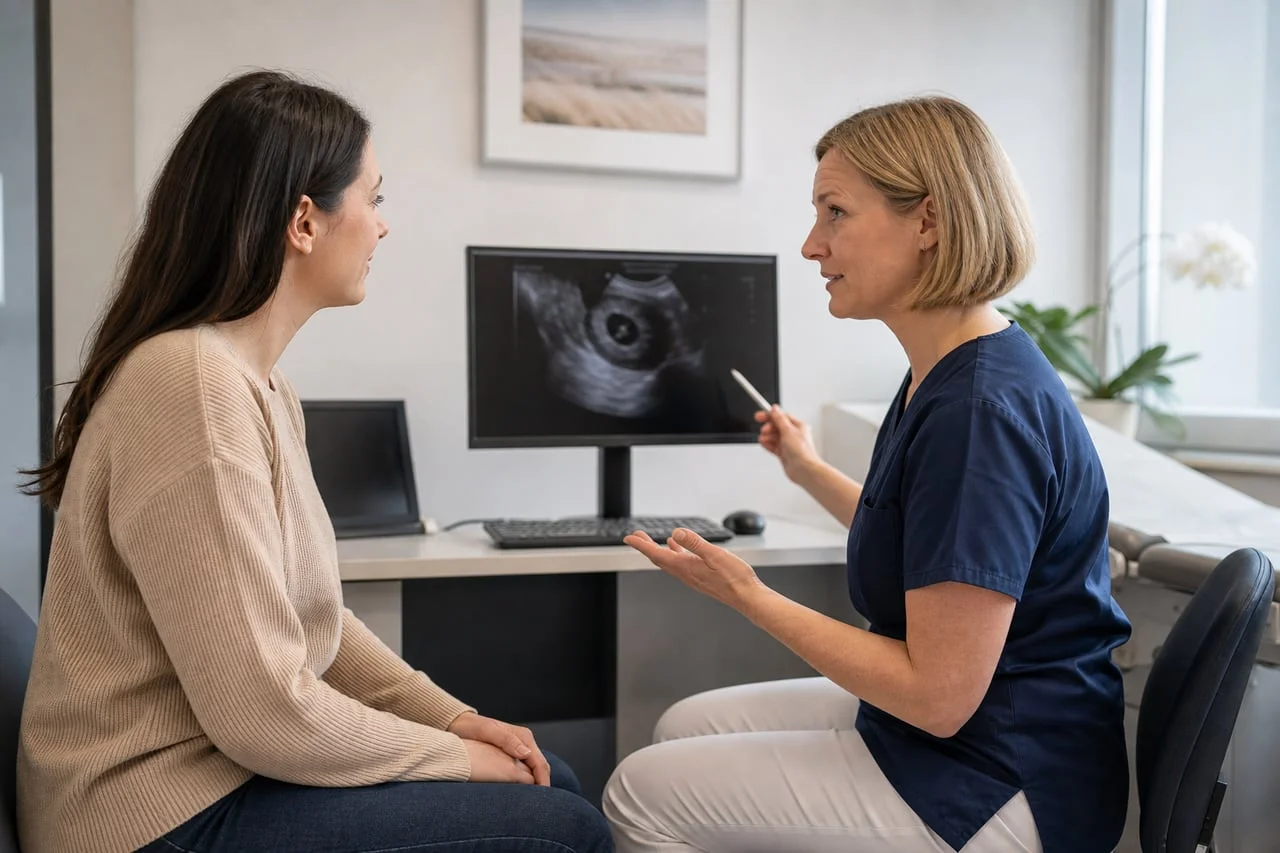
A transvaginal ultrasound scan often gives a clearer image early in pregnancy. The Royal College of Obstetricians and Gynaecologists states that neither a transvaginal nor an abdominal scan increases miscarriage risk. Ask for an explanation of the procedure, purpose, limits, and alternatives.
Why ultrasound scans and hCG tests may need to be repeated
A correctly performed ultrasound scan may still be inconclusive very early. That does not automatically mean everything is fine or that the pregnancy has ended. Gestational age, symptoms, findings, and change over time all matter.
If the test is positive but ultrasound scan cannot yet locate a pregnancy inside or outside the uterus, the temporary classification is pregnancy of unknown location, or PUL. It may represent a very early intrauterine pregnancy, an early loss, or an ectopic pregnancy.
NICE guidance on early pregnancy emphasises that hCG does not locate a pregnancy and that symptoms can matter more than a laboratory result. Healthcare professionals often compare two levels about 48 hours apart and plan another ultrasound scan when needed. Even a falling value does not automatically end follow-up while the location or outcome remains unresolved.
Possible findings and treatments
Sometimes evaluation shows a viable pregnancy and the bleeding stops without treatment; follow-up may be all that is needed. An infection, cervical finding, or placental complication is treated according to its cause.
Once early pregnancy loss is confirmed, expectant management, medication, or a procedure may be options depending on the findings, bleeding, stability, and your preferences. For ectopic pregnancy, carefully selected observation, medication, or surgery may be considered according to stability, size, hCG, and follow-up. These choices require a detailed conversation with the treating team.
Later in pregnancy, monitoring in hospital may be necessary. Depending on the week and situation, the team may assess your circulation, placenta, cervix, contractions, and fetus. Bleeding is a symptom; treatment follows the diagnosis, not the colour.
Rh status and Rh immune globulin
If you are RhD-negative, tell the treating team and bring your antenatal records if available. Whether Rh immune globulin is recommended depends on gestational age, the diagnosis, amount and recurrence of bleeding, and whether a procedure is performed.
UK recommendations distinguish by gestation, diagnosis, bleeding and treatment. The current NICE guideline sets out when anti-D is and is not offered in early pregnancy. Do not infer your treatment from one general rule; ask what applies to your exact situation.
What you can do while waiting for assessment
- Record the start, pattern, colour, approximate amount, clots, pain, and any dizziness or faintness.
- A pad is useful for estimating the amount. You do not need to diagnose blood or tissue at home.
- Have the date of your last normal period, test results, medications including blood thinners, blood type, and pregnancy history ready.
- Ask someone to accompany you if symptoms are stronger, and do not drive if you feel faint.
- Get a clear plan for follow-up, expected symptoms, warning signs, and whom to contact after hours.
Bed rest has not been shown to prevent miscarriage. Routine restriction of activity or sex is not established as protection against pregnancy loss either. Follow advice based on your health and how you feel. If sex triggers bleeding or feels uncomfortable, pause until you have guidance for comfort and clarity, not because you caused the problem.
Do not start progesterone or another new medicine on your own. NICE recommends vaginal micronised progesterone for a specific group: people with early bleeding, a previous miscarriage and a pregnancy confirmed inside the womb on a scan. Ask the treating team what applies to you and which pain relief is suitable.
If the bleeding comes back
A reassuring assessment of one light bleed is not permanent clearance. Report bleeding again if it returns, becomes heavier, or comes with new symptoms. This is especially important if you have a pregnancy of unknown location or are still waiting for scheduled follow-up.
If bleeding stops after a viable intrauterine pregnancy is confirmed, you can usually return to routine antenatal care after checking with your healthcare professional. Persistent bleeding, new pain, fever, dizziness, or faintness requires reassessment. An earlier reassuring result cannot explain a new symptom.
Myths and facts
- Myth: If bleeding arrives on time, it is a period.
- Timing can mislead. Bleeding during an ongoing pregnancy is not menstruation, even if it starts on the expected date.
- Myth: Brown blood is always harmless.
- Brown often means only that the blood is older. Cause and urgency depend on the full picture, not colour alone.
- Myth: Light bleeding rules out an ectopic pregnancy.
- An ectopic pregnancy may initially cause little bleeding. One-sided pain, shoulder-tip pain, dizziness, and fainting are important warning signs.
- Myth: Bleeding always means miscarriage.
- Many pregnancies continue after bleeding, while a loss can sometimes begin lightly. Assessment provides a more reliable answer.
- Myth: A well-rising hCG level proves the pregnancy is in the uterus.
- The pattern offers clues but cannot locate a pregnancy by itself. Symptoms and ultrasound scan remain essential with a PUL.
- Myth: An empty first ultrasound scan definitely means miscarriage.
- The scan may simply be too early. Time, repeat ultrasound scan, or further hCG tests may be needed before diagnosis.
- Myth: Everyday activity, sex, or exercise caused the bleeding.
- Contact can reveal bleeding from a sensitive cervix, but that is not the same as causing pregnancy loss. Do not rush to blame yourself.
When waiting is emotionally difficult
Bleeding in a wanted pregnancy can bring fear, grief, and a loss of control even if the pregnancy later appears healthy. A temporary diagnosis that depends on another blood draw or ultrasound scan can be particularly hard.
Ask concrete questions: What is known today? What remains uncertain? When is the next check? Which change means you should return immediately? Bring a trusted person if possible or ask them to remain available. If loss is confirmed, you can ask for emotional support as well as medical information.
Bottom line
You cannot be pregnant despite a true period, but you can be pregnant despite bleeding that resembles one. Take any pregnancy bleeding seriously without assuming the worst. A test may be the first step, but symptoms, examination, ultrasound scan, and sometimes serial hCG answer the essential questions. Heavy bleeding, severe or one-sided pain, dizziness, fainting, or shoulder pain calls for immediate medical help, not more searching online.
What to read next
These four articles explore pregnancy tests, early pregnancy loss, and the important distinction between a pregnancy in the womb and an ectopic pregnancy.