Pregnant without penetration? Petting and anal sex explained
Pregnancy is possible without vaginal intercourse if fresh semen reaches the vaginal opening or enters the vagina. Anal sex alone, kissing and touching through clothing do not cause pregnancy. What matters is the actual contact. This guide explains when emergency contraception or a pregnancy test may help.

At a glance
- The risk depends on whether fluid containing sperm reached the vaginal opening directly or entered the vagina.
- Anal sex alone does not cause pregnancy. What matters is whether semen subsequently came into contact with the vaginal opening.
- Washing or urinating does not prevent pregnancy if semen has already reached the vaginal opening or entered the vagina.
- After contact that could lead to pregnancy, the first priority is the time available for emergency contraception. A pregnancy test helps later: from a missed period, or at least 21 days after the contact if your cycle is unclear.
What without penetration actually means here
When people ask about pregnancy without penetration, they often mean that the penis did not enter the vagina. That is why anal sex belongs in this discussion, although it also involves penetration. For pregnancy risk, the question is whether sperm capable of fertilisation could enter the vagina.
The vulva is the external genital area, which includes the vaginal opening. Semen on the abdomen or thigh is therefore different from fresh semen directly at this opening. The vagina leads through the cervix to the uterus. Fertilisation usually takes place in a fallopian tube. BIÖG: Ovulation and fertilisation
This article is about a possible unintended pregnancy after sexual contact. Planned methods such as home insemination are also possible without intercourse, but address a different question.
Petting, fingers and clothing: which contact matters?
The word petting alone tells you little about pregnancy risk. Touching through clothing is different from fresh semen reaching the vaginal opening directly.
- Kissing, stroking and rubbing with clothing on
- These do not make you pregnant. If underwear or other clothing stays between the genitals and no semen reaches the vaginal opening directly, the necessary route for sperm is absent.
- Rubbing bare genitals together
- Ejaculation directly at the vaginal opening can pose a risk even without the penis entering. In principle, the same applies to direct contact with pre-ejaculate containing sperm. Bare skin contact alone, however, does not mean that sperm were actually transferred.
- Fingers or sex toys
- This can matter if still-wet semen is on them and is immediately brought to the vaginal opening or into the vagina. A clean hand or cleaned toy does not cause pregnancy. A hand having touched semen at some earlier point is not enough.
- Semen on the abdomen, buttocks or thigh
- As long as it stays there and does not reach the vaginal opening while fresh, it does not create a pregnancy risk. Wiping still-wet semen there with a hand is a different situation.
- Oral sex and swallowing
- These do not cause pregnancy. The digestive tract has no route to the uterus. Any separate, subsequent contact between fresh semen and the vaginal opening would need to be considered on its own.
The educational information from Loveline also explains when wet semen on fingers matters during petting. Avoiding this transfer means you do not need to treat every touch as a risk. Our article on petting discusses intimacy and boundaries in more detail.
Can anal sex cause pregnancy?
Anal sex itself does not cause pregnancy. The rectum and vagina are separate parts of the body; sperm do not pass through the bowel wall to the uterus. Ejaculation inside the anus does not, by itself, cause pregnancy either.
A risk can arise only through additional contact: semen runs from the anus towards the vaginal opening, fingers or toys transfer it there, or anal sex is followed by unprotected vaginal intercourse. The medical explanation from Nemours KidsHealth describes precisely this exception.
A condom breaking during anal sex therefore does not automatically mean pregnancy is possible. The question remains whether semen could reach the vaginal opening or enter the vagina. The risk of sexually transmitted infections needs to be assessed separately.
Use a new condom when switching from anal to vaginal sex. Hands and toys should also be cleaned to avoid bringing bowel bacteria into the vagina. Unprotected vaginal contact is a separate risk, even if it is brief or there is no further ejaculation.
What about pre-ejaculate without ejaculation?
Pre-ejaculate, sometimes called pre-cum, is not the same as the semen released during ejaculation. It can, however, contain sperm. No ejaculation is therefore not a reliable reason to rule out pregnancy if there was unprotected vaginal contact or the fluid directly touched the vaginal opening.
A small 2024 study examined pre-ejaculate from men experienced in using the withdrawal method. Sperm were found in some samples, with varying quantities and motility. This cannot provide a reliable percentage risk for petting. Nor does it show that a particular person's pre-ejaculate is always free of sperm. Study of sperm content in pre-ejaculate
A condom should therefore be on the penis before direct genital contact. Our article on pre-ejaculate explains its composition and the risk in more detail.
Dried semen, toilets and bathwater
Dried semen stains on bedding or clothing do not pose a pregnancy risk. Wetting them again does not restore sperm's ability to fertilise an egg. Sitting on a toilet seat or sharing a bath is not a realistic route to pregnancy either. The BIÖG's educational examples about bathwater and semen stains distinguish these everyday situations from direct contact with semen that is still wet.
Water is not contraception, however. Unprotected vaginal intercourse in water, or semen reaching the vaginal opening directly, is different from semen dispersed in bathwater.
Outside the body, how long sperm survive depends partly on whether the semen stays wet. A single time limit for skin or fabric is therefore not useful. What matters is the state of the fluid and the actual contact. Read more: How long do sperm survive?
How likely is pregnancy without vaginal sex?
There is no reliable percentage covering all these situations. Wet semen directly at the vaginal opening, a merely suspected trace on a hand and rubbing through underwear are not comparable events. Pregnancy figures for regular unprotected intercourse do not answer these individual questions.
Without a possible route to the vagina, harmless contact does not become a pregnancy risk. If fresh semen did reach the opening directly or enter the vagina, pregnancy is possible but far from inevitable. When you seek advice, these details can be assessed together: what happened, the contraception you were using and how much time has passed.
The menstrual cycle matters only if sperm could actually get there. Under favourable conditions, sperm can survive inside the body for up to five days. Ovulation can shift, so a calendar app or current bleeding cannot reliably rule out pregnancy after contact that could cause it. BIÖG: Ovulation and fertile days
What you can do after possible exposure
If you want to avoid pregnancy, you do not need to calculate an exact probability first. Recognising contact that could cause pregnancy in time, and getting advice when needed, matter more.
- Clarify the contact: Was fresh semen or fluid that could contain sperm directly at the vaginal opening? Was anything brought inside by a hand or toy? Was there actually a brief episode of unprotected vaginal contact?
- Check contraception and timing: Was a condom intact and in place from the start? Were you protected by another method used reliably? How long ago did the contact happen?
- Get prompt advice if there was a pregnancy risk: A pharmacy or gynaecology practice can help you assess whether emergency contraception is appropriate. Describe what happened as clearly as possible, even if the question feels embarrassing.
Contact through clothing, dried stains or anal sex without semen reaching the vagina does not require the morning-after pill for that event. If you cannot confidently assess what happened, explain it when seeking advice. Establishing the actual events is more helpful than imagining more and more possible routes of transfer.
What are the time windows for emergency contraception?
In Germany, the morning-after pill is available from pharmacies without a prescription. Depending on the active ingredient, it must be taken within 72 hours for levonorgestrel or 120 hours for ulipristal acetate at the latest. The sooner you seek help, the better. Mention other medicines and your usual contraception, as these can affect the choice and what to do next. BIÖG: The morning-after pill
A copper IUD is another emergency contraception option, usually within five days of the contact. It is fitted by a clinician and is the most effective emergency method. The suitable option needs to be assessed individually. The morning-after pill delays or prevents ovulation; it does not end an existing pregnancy. WHO: Emergency contraception
Do not wait for symptoms or an early test if there may have been a risk. If more time has already passed, still seek advice rather than choosing or ruling out a method yourself. Our guide to the morning-after pill explains the next steps.
Why washing, douching and urinating do not prevent pregnancy
Washing your hands thoroughly before further genital contact is sensible: it can prevent fresh semen from being transferred. That is different from trying to undo contact that has already happened at the vaginal opening by showering afterwards.
Urine comes from the urethra, not the vagina. Urinating therefore does not flush sperm out of the vagina. Washing externally is not emergency contraception either. Vaginal douching also does not prevent pregnancy and can disturb the vagina's natural environment. Office on Women's Health: Douching
You can wash the outside of your genitals normally. However, if contact that could cause pregnancy has happened, this does not replace deciding about emergency contraception or taking a test later.
When can a pregnancy test give a clear answer?
A test immediately after contact cannot detect a pregnancy resulting from that event. Most urine tests are reliable from the first day of a missed period. If you do not know when your period is due, test at least 21 days after the last contact that could have caused pregnancy. NHS: When to take a pregnancy test
Follow the instructions and read the result within the stated time. If the test is negative but your period does not arrive, repeat it after a few days. If your period still does not arrive despite further negative tests, seek medical advice. A positive test should also be discussed with a healthcare professional.
Abdominal discomfort, breast tenderness or nausea can have various causes and do not replace a test. If these signs worry you, Could I be pregnant? helps put them into perspective.
Protection next time: consider pregnancy and infections separately
No pregnancy risk does not automatically mean no infection risk. Sexually transmitted infections can be passed on during anal sex in particular, even without ejaculation. It is worth discussing protection and boundaries beforehand.
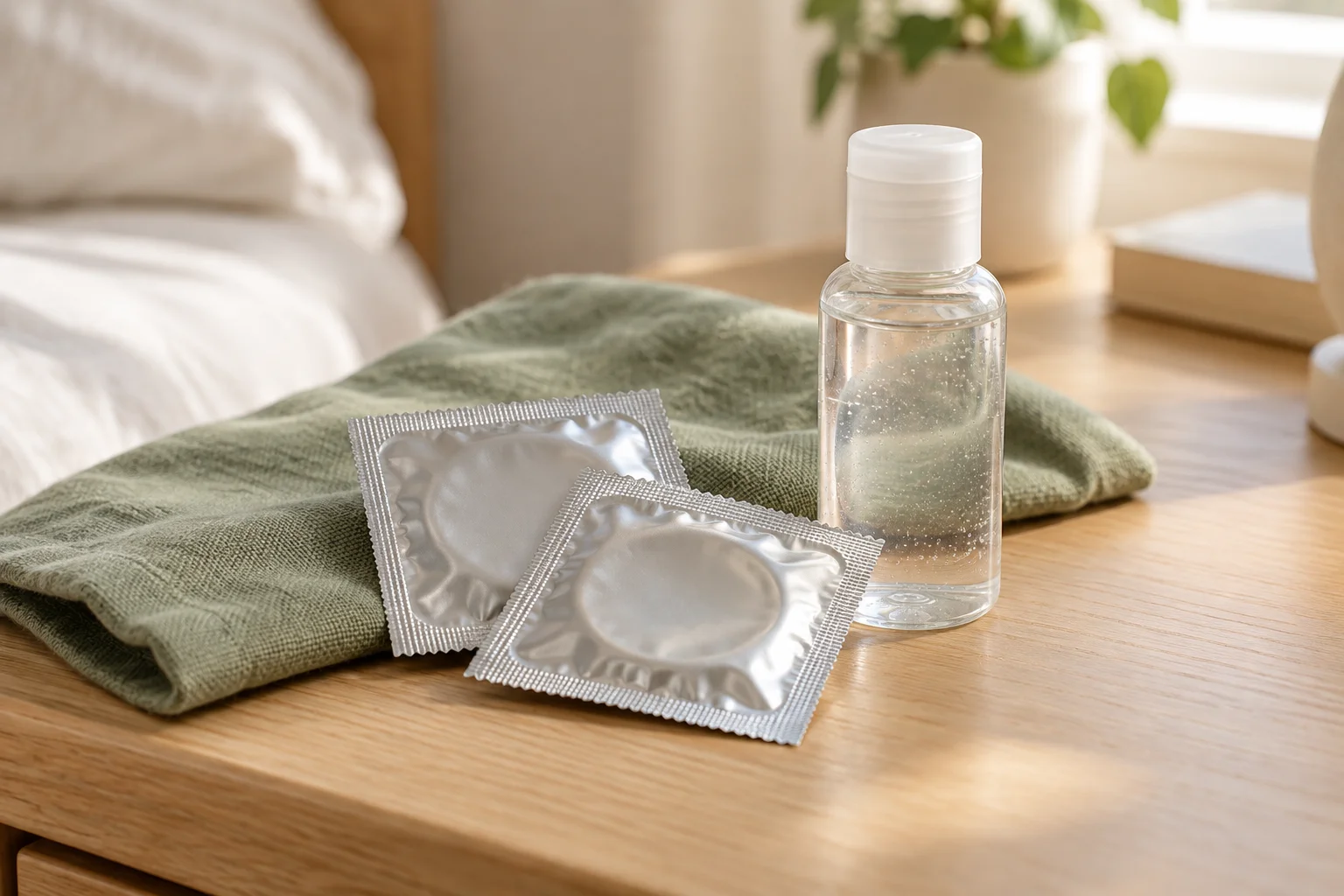
- Use a condom before the penis directly touches the vagina or anus, and a new one when switching between them.
- Use enough condom-compatible lubricant. Water- or silicone-based products are suitable for latex condoms; oil-based products can damage the material.
- Wash hands and clean toys before moving from the anal area to the vulva or vagina. Change the condom on a toy as well.
- Stop if something hurts or someone does not want to continue. Pain is not a necessary part of sex.
These precautions are explained by LIEBESLEBEN: Sexual practices and protection and the NHS guide to condoms. After a condom problem, Condom broke also offers guidance.
Have severe or persistent pain, heavy bleeding or injuries assessed promptly. After a possible HIV exposure, seek medical advice immediately because HIV PEP is time-sensitive. This needs to be discussed independently of a pregnancy test.
When worry grows beyond what happened
It is understandable to look for reassurance after an unclear experience. Sometimes people keep imagining new possibilities even though no direct contact between semen and the vaginal opening can be identified.
Take a moment to write down what actually happened. If there is a plausible risk, advice and a definite test date can help. If fear continues to trouble you despite a clear explanation of why there is no risk, a conversation with a healthcare professional or counsellor may help more than repeated searches for increasingly unlikely scenarios. There is no need to feel ashamed of asking.
Myths and facts
- Myth: Pregnancy is always impossible without vaginal intercourse.
- Fact: Fresh semen can also reach the vaginal opening from outside or on fingers. This contact matters, not the name of the sexual activity.
- Myth: Semen can travel directly from the bowel to the uterus.
- Fact: The bowel and vagina are separate. Pregnancy risk during anal sex arises only if semen also reaches the vaginal opening or enters the vagina from outside.
- Myth: Sperm pass through clothes or become active again in dried stains.
- Fact: Rubbing through clothing and dried semen stains are not realistic routes to pregnancy. Fresh semen directly at the vaginal opening is a different situation.
- Myth: Nothing can happen without ejaculation.
- Fact: Pre-ejaculate can contain sperm. Unprotected vaginal contact therefore cannot be assumed safe simply because there was no ejaculation.
- Myth: Washing or urinating afterwards prevents pregnancy.
- Fact: Neither replaces emergency contraception. Cleaning before further contact can prevent transfer; cleaning afterwards does not undo contact that has already occurred.
- Myth: A test the next morning rules out pregnancy.
- Fact: That is too early. The timing depends on when the period is due or how long it has been since the last contact that could cause pregnancy.
Conclusion
Pregnancy without vaginal intercourse is possible if fresh fluid containing sperm reaches the vaginal opening or enters the vagina. Anal sex alone, kissing, touching through clothing and dried semen stains do not cause pregnancy. This distinction matters more than the name of the sexual activity.
If that contact happened, seek advice about emergency contraception promptly and plan a test at the appropriate time. Without it, the forms of contact described do not pose a pregnancy risk. Clear agreements, condoms and avoiding direct transfer of semen can help next time.
Further reading
Read more about pre-ejaculate, petting, emergency contraception and when a pregnancy test is useful.