Sex for the first time: preparation, positions, pain, bleeding and protection
Having sex for the first time is not about following a perfect script. Freely given consent, protection, enough time and knowing that anyone can slow down or stop matter far more. This guide answers common questions about preparation, positions, pain, bleeding, pregnancy and what may be important afterwards.


The essentials for your first time
Your first time does not need to be perfect or painful. A positive experience starts not with a particular position, but with everyone freely wanting it, feeling safe and being able to stop whenever they choose.
- There is no correct age and no personal deadline.
- Vaginal penetration is optional and can always wait until another time.
- A condom goes on the erect penis before it touches the vulva or vagina.
- More time, arousal and suitable lubricant can reduce friction and pain.
- Bleeding may happen, but it is not inevitable and does not prove virginity.
- Severe or worsening pain is a signal to stop, not something you have to tolerate.
What does the first time actually mean?
People use the first time to mean different things. For some, it is their first intimate contact; for others, it means oral sex or the first time they have vaginal or anal intercourse. No medical examination can determine whether somebody has had sex.
This article concentrates on questions that often arise before vaginal intercourse for the first time: How can you prepare? Which positions are easier to control? Can it hurt or cause bleeding? How can you protect yourselves? For a wider introduction to different forms of sexual intimacy, see How does sex work?.
How can you tell whether you are ready?
There is no age by which you ought to have had sex. Statistics describe groups, but they do not set a deadline for your life. The important question is not whether other people started sooner, but whether this situation feels voluntary, safe and right for you.
It may help to ask yourself:
- Do I want this myself, or am I mainly worried about disappointing somebody?
- Can I say no, slower or stop without being frightened?
- Will the other person accept my answer without arguing or making me feel guilty?
- Are we sober enough to make clear decisions about condoms, contraception and protection from infection?
- Do we have privacy and enough time, without worrying that somebody will interrupt us?
- Would it also be all right if we only kissed, touched each other or stopped completely?
If one answer is uncertain, that does not necessarily mean never. It may simply mean not yet, not today or not with this person.

Consent is more than saying yes once
Consent must be freely given and continue throughout the experience. Agreeing to kiss is not automatic consent to penetration. A previous yes does not apply later, and anybody may change their mind during sex.
Brief, clear questions are usually enough: Does this feel good? Shall I slow down? Would you like to continue? Answers can be equally clear. Silence, freezing or turning away is not a dependable yes. If you are unsure, pause and ask.
Alcohol and other substances can affect perception, erections, vaginal lubrication and decision-making. Somebody who can no longer decide freely and clearly cannot give valid consent.
What to discuss and prepare beforehand
Preparation does not make the moment less special. It means that important decisions are not left until you feel under pressure.
- What would you both like to try, and what do you definitely not want?
- Which contraception will you use, and will you use a condom as well?
- What will you do if somebody wants to stop or the condom fails?
- Are well-fitting, unexpired condoms within easy reach?
- Do you have condom-compatible lubricant if you need it?
- Do you have sufficient time, privacy and a straightforward way to get home?
Oil-based products can damage latex condoms. Water- or silicone-based lubricants are safe choices with latex. Using two condoms together creates extra friction and makes breakage more likely. How to use a condom correctly explains the practical steps.
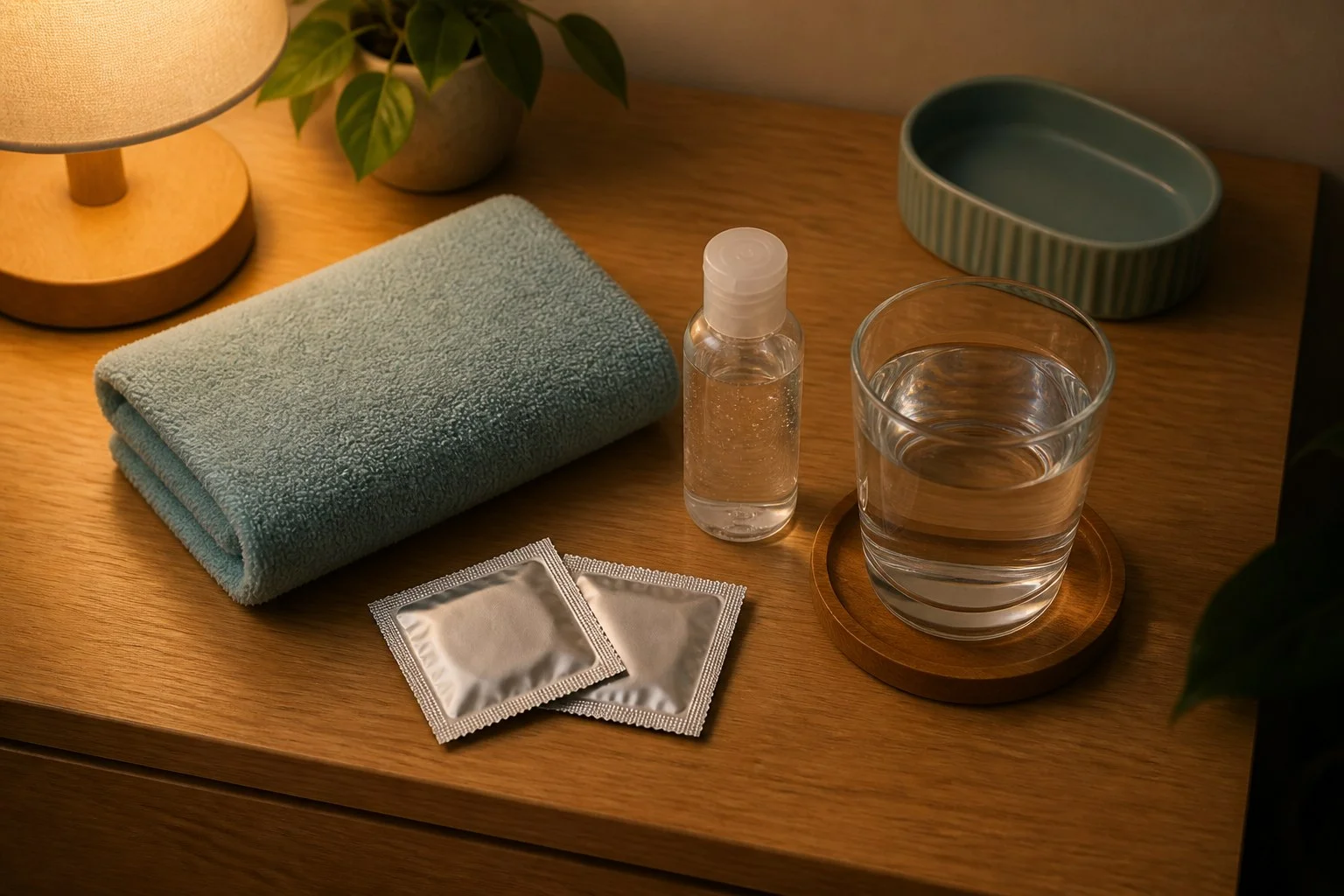
What might the first time really be like?
There is no required order. Sex often begins with closeness, kissing and touching. This gives you time to notice what feels good and gives the body time to become aroused. An erection or vaginal lubrication may appear, change or fade. That does not judge the strength of your feelings.
If you both want vaginal intercourse, put the condom on before the penis touches the vulva or vagina. If there is dryness, a small amount of suitable lubricant can go on the outside of the condom and around the vaginal opening. Begin with small, slow movements. The receiving person can use a hand, adjust their pelvis or speak to help control depth and speed.
If penetration is not working or does not feel good, return to touching or stop altogether. Sexual touching and closeness without penetration are neither incomplete sex nor a failed attempt.
Which position may be suitable for the first time?
No single position is best for everybody. A helpful position allows you to speak to each other, keeps movements small and lets the receiving person influence pace and depth easily.
- The receiving person on top
- This can provide considerable control over pace, angle and depth, and it is usually easy to stop quickly. It is only a good choice if the person on top feels secure rather than watched or under pressure to perform.
- Lying side by side
- Side-by-side positions often allow slow, small movements with little effort. This may feel comfortable when you are nervous, although finding the right alignment sometimes takes patience.
- Facing each other with the receiving person underneath
- This position offers closeness and eye contact. The person on top should support their own weight, start slowly and not decide the pace alone.
A complicated position is rarely useful the first time. A pillow may make a position more comfortable, but it is not essential. The important points are that nobody is held in place and that a request to stop is acted on immediately.
Does sex hurt the first time?
It may feel unfamiliar. Mild pressure, a brief pulling feeling or burning caused by friction can occur. Severe, sharp or increasing pain is not, however, an unavoidable part of the first time.
Common reasons for discomfort include too little time for arousal, dryness, tension in the pelvic floor, movements that are too fast or deep, and pressure to make it work. Pain may also have other causes, including infection, irritated skin, vaginismus, vulvodynia or endometriosis. A single symptom cannot identify the cause with certainty. The American College of Obstetricians and Gynecologists guide to pain during sex describes possible causes and treatments.
If it hurts, stop. Change position or pace, allow more time and use lubricant if needed. If it does not become clearly more comfortable, stop for the day. Forcing through pain can increase fear, muscle tension and small injuries.
What if penetration is not possible?
Do not force it. The pelvic floor sometimes tightens involuntarily when somebody is anxious or afraid. Sometimes the angle, lubrication or pace is not right. This does not mean that anybody's body is too tight or damaged.
Take a step back: pause, breathe calmly, spend more time on pleasurable touch, use lubricant if needed and choose a position that gives the receiving person more control. You can leave penetration for another day without turning it into an examination you must pass.
If inserting tampons, having examinations or attempting penetration is repeatedly almost impossible or immediately causes severe pain, a gynaecological or sexual-health assessment may help. Understanding vaginismus explains how involuntary tightening can be treated.
Do people bleed the first time?
Some people notice a few drops of blood or light spotting; many do not bleed at all. Both experiences can occur. Light bleeding is more likely to result from friction and small, superficial injuries to delicate tissue than from a supposed seal that must break during first-time sex.
The hymen is a rim of tissue around the vaginal opening that varies in shape and is often elastic. Its appearance and any bleeding cannot prove whether somebody has previously had vaginal sex. The World Health Organization states that so-called virginity testing has no scientific basis. Read The hymen and virginity myths for more about anatomy and uncommon variations.
Heavy bleeding, bleeding with severe pain or faintness, or bleeding that does not ease needs medical assessment.
Can you become pregnant the first time?
Yes. The body makes no exception for the first time. Pregnancy may be possible if sperm reaches the vagina or the area around it. Withdrawal is not reliable contraception because timing can go wrong and situations involving pre-ejaculate and ejaculate are not always clearly separated.
Condoms help to prevent pregnancy and reduce the risk of many sexually transmitted infections. They do not protect completely against every STI because some can pass through contact with uncovered skin. Another contraceptive method may improve protection against pregnancy, but it does not replace protection against infection.
The World Health Organization summarises the benefits and limitations of condoms. The NHS guide to condoms also provides current practical instructions.
What should you do after unprotected sex or a condom problem?
If the condom broke or slipped off, went on too late or was not used, time matters. Depending on the situation, emergency contraception and advice about STI testing may be appropriate. The available methods have different time limits; the sooner you seek advice, the more options you may have.
The NHS explains emergency contraception and the relevant time limits. For practical next steps, see What to do when a condom breaks or slips off and Emergency contraception.
STIs do not always cause symptoms straight away. Medical or sexual-health advice may therefore be sensible after a possible exposure even if you feel well.
What is normal after the first time?
Some people feel happy and connected; others feel tired, thoughtful, uncertain or surprisingly neutral. A feeling does not have to prove whether the decision was right or wrong. A brief conversation may help: How are you? Was anything uncomfortable? Would you like closeness or some space?
Remove the condom carefully and check whether it has visibly broken or slipped. Washing the outside of the genitals with water is normally enough; vaginal douching is unnecessary and can disturb the natural environment. Mild irritation may improve with rest. Do not test persistent or worsening discomfort by trying again.
Myths and facts about the first time
- Myth: There is a normal age by which everybody should have had sex.
- Fact: There is no personal deadline. Consent and readiness matter more than an average age.
- Myth: Sex must hurt the first time.
- Fact: Unfamiliar pressure may occur, but severe pain is not required and should not be endured.
- Myth: Bleeding proves virginity.
- Fact: Many people do not bleed. Neither bleeding nor the appearance of the hymen can reliably show somebody's sexual history.
- Myth: One position is perfect for everybody.
- Fact: A controllable pace, little pressure and clear communication matter more than a position's name.
- Myth: Without an orgasm, it was not real sex.
- Fact: Orgasm is not compulsory. Excitement and unfamiliar sensations can affect arousal, especially the first time.
- Myth: If an erection fades, there is no attraction.
- Fact: Stress, pausing to put on a condom, tiredness and performance pressure can affect an erection without revealing anything about somebody's feelings.
- Myth: Once you start, you have to continue.
- Fact: Anybody may stop at any time, regardless of what was agreed or started earlier.
When to seek medical help
Consider a medical or sexual-health assessment if:
- pain is severe, sharp or increasing,
- pain returns during later attempts,
- bleeding is heavy or does not stop,
- you also develop a fever, unusual discharge, severe itching or burning when urinating,
- penetration or inserting a tampon remains almost impossible despite taking your time,
- you need help assessing pregnancy or STI risks after a condom problem.
Seek prompt medical help for very heavy bleeding, fainting, circulatory problems, sudden extreme pain or an acute injury. If somebody ignored your boundaries or pressured you into sex, it is not your fault. A trusted person, support service or medical professional can help.
In summary: safety matters more than perfection
A good first time cannot be measured by duration, position, penetration, bleeding or orgasm. It comes from deciding freely, communicating, using protection and taking physical signals seriously. You may go slowly, laugh, pause, change something or stop completely. That freedom is what turns a sequence of events into a shared experience.
More about protection, your body and communication
These articles explain how sex works, how to use a condom correctly, what the hymen is and why penetration may sometimes hurt.