Can you get pregnant from pre-cum? Risk and next steps
Yes, pre-cum can lead to pregnancy, even when there is no ejaculation inside the vagina. Pre-ejaculate does not always contain sperm, but it can carry them. Learn where the fluid comes from, how to understand common situations, and what steps make sense after unprotected contact.


At a glance
- Pregnancy is possible without visible ejaculation if sperm-containing fluid gets into the vagina.
- Pre-ejaculate is different from semen; some samples contain no sperm, and the findings cannot provide a reliable pregnancy percentage for a single encounter.
- Withdrawal is vulnerable to mistakes; putting on a condom late does not protect against the contact that has already happened.
- Sexually transmitted infections can spread without ejaculation; condoms reduce many of these risks but do not eliminate them altogether.
- If contact may have occurred without effective contraception and you want to prevent pregnancy, get advice about emergency contraception promptly.
Is pregnancy possible without ejaculation?
Yes. There does not have to be a visible ejaculation inside the vagina for pregnancy to occur. The key is whether sperm get into the vagina and can then reach an egg that can be fertilized.
Contact with pre-ejaculate can make that possible too. Withdrawal or putting a condom on too late involves a pregnancy risk if another effective contraceptive method is not in place. It is usually difficult to establish afterwards whether fluid containing sperm was released.
The situation behind the question
When people ask about pre-cum, they often mean more than the fluid itself: putting a condom on late, withdrawal, brief contact at the vaginal opening, or sexual touching with fresh fluid on fingers or genitals.
Pregnancy requires three things to come together: sperm must be present, they must enter the vagina, and the timing must be within the fertile window. Without knowing that context, a percentage or a personal account can seem more definite in hindsight than the situation supports.
What is pre-cum, and where is it made?
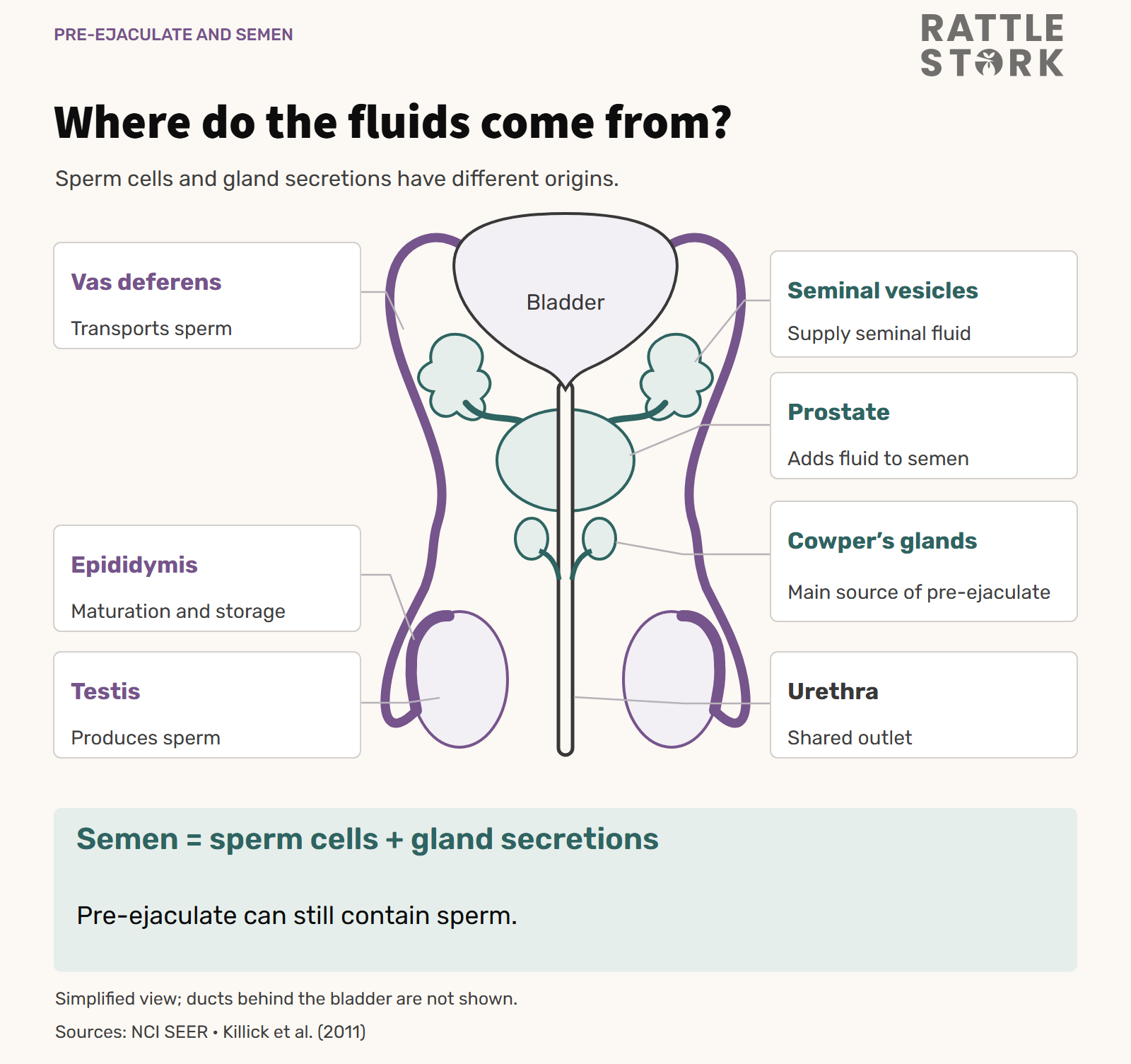
Pre-cum is called pre-ejaculate in medical language. It is fluid that can come out of the penis during sexual arousal before ejaculation. It comes mainly from the bulbourethral glands, also called Cowper's glands, and helps keep the urethra moist.
Pre-ejaculate is not the same as semen. The testicles produce sperm, while other glands add their secretions during ejaculation.
- Testicles and epididymis
- Sperm form in the testicles. They mature and are stored in the epididymis before moving through the sperm ducts, called the vas deferens.
- Seminal vesicles and prostate
- Their secretions account for a large part of the fluid in semen. Semen is not made up of sperm alone, nor does it come entirely from the testicles.
- Cowper's glands
- These glands release a secretion during arousal that may come out before ejaculation. The glands do not make sperm themselves.
- Urethra
- It provides a shared way out of the body. A shared exit does not make pre-cum and semen the same fluid.
NCI SEER provides the anatomical explanation of the glands involved and how sperm are transported.
Does pre-cum have sperm in it? What research shows
Research findings vary. A frequently cited study detected sperm in some pre-ejaculate samples, including sperm that were able to move. Sperm content of pre-ejaculatory fluid (NCBI/PMC)
A 2024 pilot study of 24 men with experience using withdrawal also detected sperm in only some pre-ejaculate samples. It measured sperm counts and movement rather than the number of pregnancies that actually occurred. Pilot study of sperm in pre-ejaculate (PubMed)
Saying that sperm in pre-cum are always simply left over from an earlier ejaculation does not fully explain the findings. The origin of the sperm detected has not been conclusively established either. Urinating after ejaculation is therefore no guarantee that pre-ejaculate will contain no sperm during the next encounter. The AWMF guideline on non-hormonal contraception considers the evidence on this inadequate.
What this means in practice is that neither appearance nor sensation can tell you if sperm were present. The important questions are whether sperm-containing fluid could have reached the vagina and whether effective contraception was being used.
What are the chances of pregnancy?
No reliable percentage describes the chance of pregnancy from pre-cum during a single encounter. Studies that look for sperm in pre-ejaculate do not measure how often those findings result in pregnancy. Personal accounts cannot establish the probability either, because the precise events are rarely possible to reconstruct with certainty.
Typical-use data for contraceptive methods are more helpful for understanding how reliably a method works. Withdrawal is prone to errors in everyday use: about 20 out of 100 women become pregnant during the first year of typical use. AWMF S2k guideline on non-hormonal contraception (March 2025)
This is a figure for an entire year of using the method, not for having sex on one occasion. It does not say that 20 per cent of encounters involving pre-cum lead to pregnancy. For more about using withdrawal, read our article on coitus interruptus.
Fertile days and ovulation: why the date matters
If sperm reach the vagina, the days before and around ovulation are particularly important. Sperm can survive up to five days in favourable conditions. That means sex a few days before ovulation can also lead to pregnancy. There is an overview in Ovulation and fertile days.
If you use ovulation tests, it is worth looking at LH tests as well. Testing errors and misunderstanding the time window can make a situation seem safer than it is.
The following patterns can change how the risk is understood:
- Fluid at the vaginal opening: fresh fluid containing sperm can be relevant if it then gets into the vagina.
- A condom put on late: before it is put on, there is no condom protection. If no other effective contraception is in use, that contact is relevant when considering pregnancy.
- Another round of sex: semen remaining after a previous ejaculation may play a part. Use a fresh condom for the next round.
- The cycle timing is uncertain: ovulation is often only roughly estimated and can shift.
Understanding common situations
You do not need to reconstruct every detail perfectly. An initial assessment can usually start by identifying which of a few common situations fits.
- Withdrawal: the risk may be lower than if ejaculation occurs inside the vagina. As the only method of contraception, however, withdrawal is still prone to errors.
- A condom put on late: it cannot provide protection before it is on. If there is no other effective contraception, the earlier contact alone can matter.
- Sexual touching or finger contact: there is no plausible route to pregnancy without sperm-containing fluid coming into direct contact with the vagina or its opening.
- Brief vaginal contact: even a short period of penetration without a condom can matter if no other effective contraception is being used.
- No penetration: what counts is whether fresh sperm-containing fluid reached the vaginal opening directly or entered the vagina. Read more about pregnancy without penetration.
- Several encounters within a short time: the question is whether sperm could have reached the vagina or its opening during any of them. Counting the rounds alone cannot give you a risk calculation.
Both handling and when a condom is put on can be involved in a condom mishap. The article Condom broke covers what to do after a tear, slipping or putting one on late.
The article How long do sperm survive? explains survival under different conditions.
Pre-cum and sexually transmitted infections
It is common to think only about pregnancy in connection with pre-cum. But another point can be equally important: unprotected contact can pass on sexually transmitted infections regardless of whether ejaculation happens.
Condoms reduce the risk substantially, but they do not offer complete protection in every situation, including contact with infected areas of skin. A clear overview is provided by gesund.bund.de: Sexually transmitted infections.
Pre-cum: myths and facts
- Myth: Pre-cum is semen.
- Fact: Pre-ejaculate is a separate fluid; sperm are not produced in pre-cum.
- Myth: There are always sperm in pre-cum.
- Fact: Sperm are not found in every sample. If they are present, you cannot tell by looking or confidently trace them to an earlier ejaculation.
- Myth: No ejaculation inside the vagina means nothing can happen.
- Fact: What matters is whether any sperm entered the vagina, such as through early contact, a late condom or withdrawing too late.
- Myth: Withdrawal is nearly as reliable as a condom.
- Fact: Withdrawal is considerably more prone to mistakes in typical use.
- Myth: Putting a condom on at some point is enough.
- Fact: Protection requires a correctly fitted condom before the first genital contact and continued use until the end.
- Myth: Brief contact does not matter.
- Fact: Sperm reaching the vagina is more important than how long the contact lasted.
- Myth: Outside the fertile days, there is no risk.
- Fact: Risk is generally lower, but the cycle and the time of ovulation are often only estimated.
- Myth: Rinsing or showering after sex reliably reduces the risk.
- Fact: Once fluid has entered the vagina, this is not a reliable method.
Choosing reliable contraception
If uncertainty after sex is repeatedly distressing, contraception counselling may help. Correct condom use from the start reduces the risk of pregnancy and many sexually transmitted infections. A doctor or counselling service can discuss which additional method suits your day-to-day life.

The AWMF guideline linked above is a sound resource for an overview of sources of error and the reliability of non-hormonal methods.
A quick check before seeking advice
These details are particularly helpful in a consultation:
- Was there vaginal contact without a condom, or did fluid get to the vaginal opening?
- Could the fluid have contained sperm, for example pre-ejaculate or semen?
- Was another effective method being used, such as the pill taken correctly or an intrauterine device (IUD)?
- How long ago was the contact, and is the point in the menstrual cycle known?
These questions can guide a consultation, but they do not let you calculate an exact risk. Vaginal contact without effective contraception can itself be a reason to discuss emergency contraception. A rough estimate of ovulation is not enough to rule out risk.
What should you do after unprotected contact?
If you want to prevent pregnancy and vaginal contact may have occurred without reliable pregnancy protection, talk to a pharmacist or doctor about emergency contraception as soon as possible. Depending on the active ingredient, the emergency contraceptive pill can be used up to three or five days after sex, preferably as early as possible. A copper IUD may also be an option for emergency contraception. Find more information at familienplanung.de and in our article on the morning-after pill.
A urine pregnancy test is usually useful from the day your period is expected. If you are not sure when it is due, test at least 21 days after the last unprotected sex. A negative test taken too soon does not reliably rule out pregnancy; if your period does not arrive, repeat it a few days later. NHS: When to take a pregnancy test.
After possible contact with a sexually transmitted infection, advice can help you work out which tests are appropriate and when to take them. This depends on the infection and when the contact occurred. Have pain, fever, unusual discharge, bleeding between periods or severe lower abdominal pain assessed by a doctor.
Conclusion
Pre-cum can contain sperm and lead to pregnancy without ejaculation inside the vagina. This does not make it possible to calculate an exact probability for one encounter. The type of contact, the contraception actually used and the timing are what matter. After a possible contraception mishap, prompt advice is more helpful than a percentage that only appears precise.
Keep reading
More information about pregnancy risks, tests and the steps to take after a birth control mishap.