
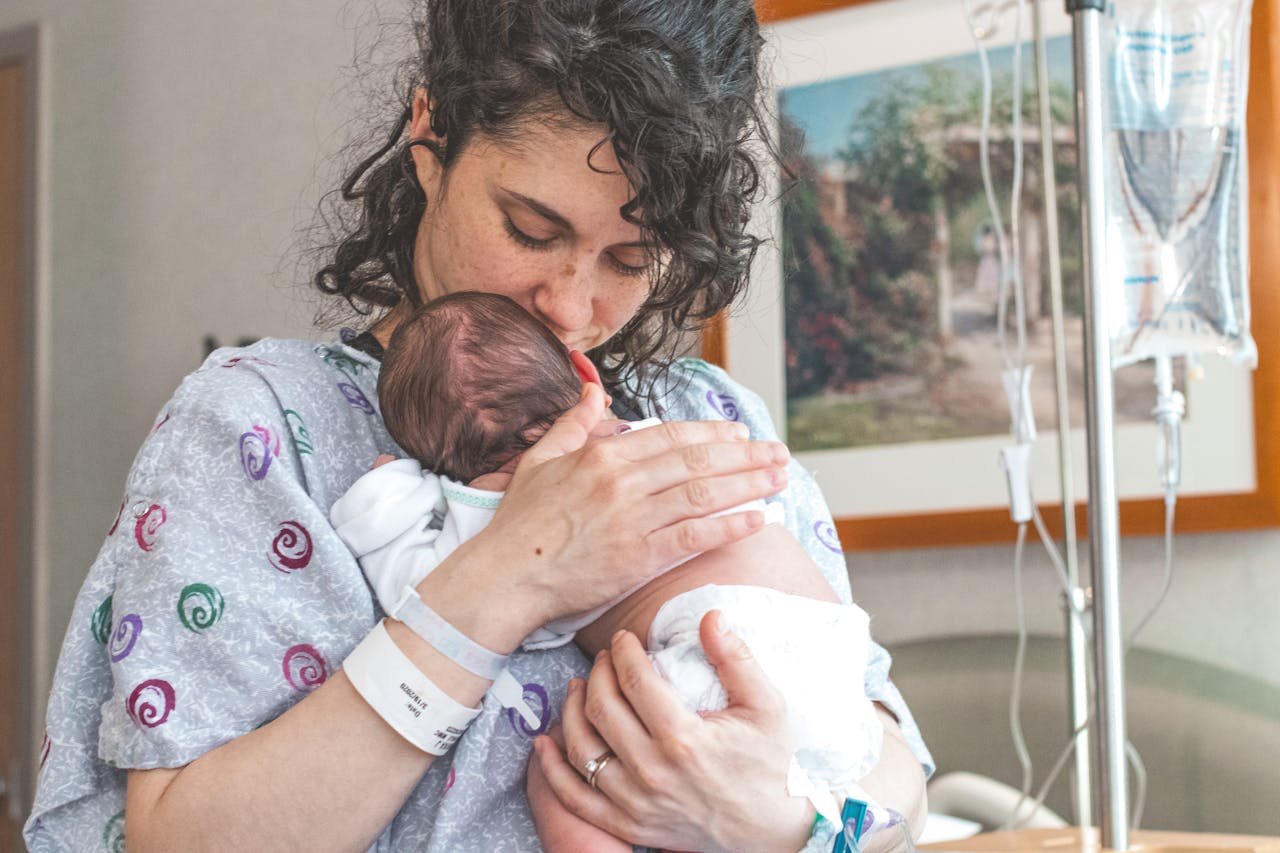
The time after birth is not a fixed fertility phase
Many people look for a simple rule: infertile right after birth, fertile again later, then the first period, and finally normal again. In reality, the time after delivery is much more flexible biologically. The body goes through a transition phase in which recovery, breastfeeding, hormone shifts, and day-to-day strain all act together.
Fertility is often reduced at first, but that does not mean it is safely switched off. The key question is when the hypothalamic-pituitary-ovarian axis becomes active enough again for follicles to mature and ovulation to become possible.
If you want the common misconception around this topic first, read the companion article Can women get pregnant again sooner after birth?.
What happens hormonally after birth?
Once the placenta is out, pregnancy hormones fall quickly. At the same time, prolactin stays high, especially when breastfeeding is frequent. A recent review says this prolactin effect helps suppress pulsatile GnRH release, which lowers FSH and LH and can delay or suppress ovulation. PubMed: Re-embarking in ART while still breastfeeding
That explains why many people go through a stretch without ovulation and without a period after birth. It also explains why that stretch varies so much from person to person: it depends not only on the delivery itself, but very strongly on feeding patterns.
Why breastfeeding plays such a big role?
Frequent breastfeeding acts like a biological signal that the body is still focused on the baby already here. The more intensive and regular the feeding, the stronger that effect can be.
The CDC describes the lactational amenorrhea method as a temporary contraceptive option with three conditions: no bleeding, exclusive or nearly exclusive breastfeeding, and fewer than six months after birth. If all three conditions are met, LAM can be temporarily effective. CDC: Lactational Amenorrhea Method
The other side of that coin matters too: once formula is added, feeds are spaced farther apart, or sleep and feeding patterns change, the reliability drops. Breastfeeding can slow fertility return, but it does not stop it completely.
What is different if you are not breastfeeding?
For people who are not breastfeeding, the prolactin-related brake is much smaller. The CDC says that in the first four weeks after birth, clear fertility signs are usually not yet expected, but ovulation before the first menstrual bleed is still common. CDC: Postpartum fertility and fertility awareness methods
In practical terms, that means not breastfeeding does not instantly restore a normal cycle, but it usually allows ovarian function to return earlier than intensive breastfeeding does.
What you should not infer from breastfeeding?
Breastfeeding is a biologically meaningful factor, but it is not an automatic substitute for contraception. The common mistake is to turn a real delay into a hard block. That is not how it works after birth.
For day-to-day life, that means this: if you rely on breastfeeding, you need to know exactly which conditions make LAM work. If you are not consciously checking those conditions, you should not treat it as dependable protection.
If you want the other side of the topic, the myth article Can women get pregnant again sooner after birth? is the right complement.
What LAM means in practice?
LAM is not just "I breastfeed, so I am protected". The method only works if feeding intervals remain tight and there is no return of bleeding. According to the CDC, that also means feeds should stay close together: during the day, no more than four hours between feeds, and at night no more than six hours. CDC: Details on LAM
Just as important, LAM does not protect against sexually transmitted infections. If that matters for you, condoms or another barrier method still matter. That is not a side note, but part of a realistic view of breastfeeding as a contraception approach.
If you do not actively meet those conditions, it is better to think of breastfeeding as a delay than as contraception.
Why the first period is not a good safety marker?
The first visible bleed is often treated as proof that fertility has returned. Medically, that is too late. Ovulation comes before a period, and that ovulation may already have returned after birth before any bleeding is visible.
That is why waiting for a period is not enough. If you want to avoid pregnancy right now, you need to think in the other direction: not bleed first and then plan, but plan before the point where unprotected sex becomes relevant again.
If you want to follow that timing more closely, the article Why you can get pregnant again before the first period after birth is the natural next step.
What fertility return looks like in practice?
Fertility returning after birth is often not a sudden switch, but a gradual process. The 2025 review describes that ovarian function after birth does not have to move immediately into a stable, regular cycle, but may pass through in-between stages where hormonal activity rises before the rhythm becomes predictable again. PubMed: Review on breastfeeding and return of fertility
That matters because it explains why body signs are often harder to read during this time. Anyone tracking cervical mucus, temperature, or cycle days will hit limits much sooner than in a stable cycle.
What official recommendations make of this?
Official guidance therefore focuses less on guessing the exact moment and more on having a clear contraception plan. The CDC clearly describes when LAM makes sense and when postpartum situations make fertility awareness methods less reliable.
That is also why contraception counselling is useful before the cycle visibly returns. In practice, the earlier conversation with a doctor or gynaecologist is often the more important one.
If you want to place the whole post-birth phase in context, the overview on the postpartum period is also helpful.
What everyday life after birth is often misread as?
After birth, body signs are unsteady not only hormonally, but also practically. Sleep loss, changing feeds, and lochia can make the picture harder to read. That is exactly why classic cycle tracking works worse in this phase than later in life.
That is not a reason to panic. It is a reason to use a different approach: less guessing from small signs, more relying on a clear family planning plan that was discussed in advance.
When the cycle is considered stable again?
The first bleed after birth is not proof of a reliable rhythm yet. The CDC points out that the first postpartum menstrual cycles can vary a lot in length while breastfeeding and that it may take several cycles before regularity returns. Only then do calendar-based methods start to become more useful again. CDC: Fertility awareness and postpartum cycles
That is one reason apps and calendars after birth often suggest more certainty than they really have. While the cycle is still shifting, they tell a hopeful story rather than a reliable timeline.
What many people forget: short spacing between pregnancies?
The question is not only whether pregnancy can happen again after birth, but whether it should happen again that soon. The 2025 review notes that short interpregnancy intervals are associated with poorer outcomes and that longer spacing matters in birth spacing guidance. PubMed: Review with interpregnancy interval discussion
That does not mean every early pregnancy is automatically a problem. It means the time between two pregnancies is medically relevant and should not be left to chance.
What you should plan concretely?
- Talk about family planning before the first bleed, not after.
- Assess breastfeeding realistically rather than treating it as automatic protection.
- Expect body signs after birth to be irregular and harder to read.
- Choose a method that still works when you are tired and juggling a lot.
- If there has been a contraception failure or unprotected sex, consider options like the morning-after pill early.
Planning early and pragmatically reduces not only the risk of an unplanned pregnancy, but also the pressure in an already intense life phase.
What is not true?
- It is not true that the postpartum period is automatically a safe infertile phase.
- It is not true that breastfeeding always protects reliably against a new pregnancy.
- It is not true that the first period is the first relevant marker that fertility is back.
- It is not true that the return of fertility after birth is always easy to recognise.
Read more
Conclusion
After birth, fertility is usually reduced at first, but not safely switched off. Breastfeeding can delay the return of ovulation and the period, but that effect depends on conditions and weakens when feeding patterns change. If you do not want to get pregnant again right away, do not wait for visible cycle signs. Choose family planning early, realistically, and without wishful thinking.