How deep is the vagina? What is normal and what matters during sex
The vagina is often about 7 to 10 centimetres long at rest. Yet a longer penis can fit comfortably: the canal can stretch, changes shape during arousal, and does not need to take in the entire penis. The important point is not just the number, but how depth, pressure and touch feel. Recurring pain should be assessed even when the measurements are within the usual range.


In brief
- The resting measurement and a comfortable depth of penetration are not the same. A number in centimetres does not decide what must fit during sex.
- Arousal can create more space in the upper vagina; there is no fixed doubling rule that applies to everyone.
- Tightness at the entrance, friction and pressure deep inside can have different causes and need different adjustments.
- Frequent sex does not permanently widen the vagina. Its width cannot reveal someone's sexual history.
- Repeated pain, bleeding or a new feeling of pressure should be checked by a gynaecologist.
How deep is the vagina in centimetres?
Cleveland Clinic gives about 7 to 10 centimetres as a rough guide for the vagina when it is not aroused. This is the inner canal from the vaginal opening to the area of the cervix. It is not an ideal measurement: a shorter or longer measurement alone does not mean that there is a medical problem. Cleveland Clinic: anatomy of the vagina
Then how can sex with a longer penis be possible? The measurement describes a resting state. The vaginal walls can move, and the shape, tension and position of nearby structures change during sex. A penis also does not have to be fully inserted.
A length measurement is therefore neither an upper limit nor a target you must reach. There is no particular number of centimetres beyond which sex automatically becomes good, bad or painful.
Where the vagina lies and why it is not a straight tube
The vagina lies in the pelvis between the urinary bladder and rectum. It runs upwards and backwards at an angle, with the cervix projecting into its upper end. The small opening in the cervix leads into the uterus. During vaginal sex, a penis stays in the vagina and does not pass through the cervix into the uterus.
The genital parts visible outside the body are called the vulva. They include the labia and the visible part of the clitoris. The appearance of the vulva does not tell you the length or width of the internal canal. Our article on the vulva and vagina explains the difference.
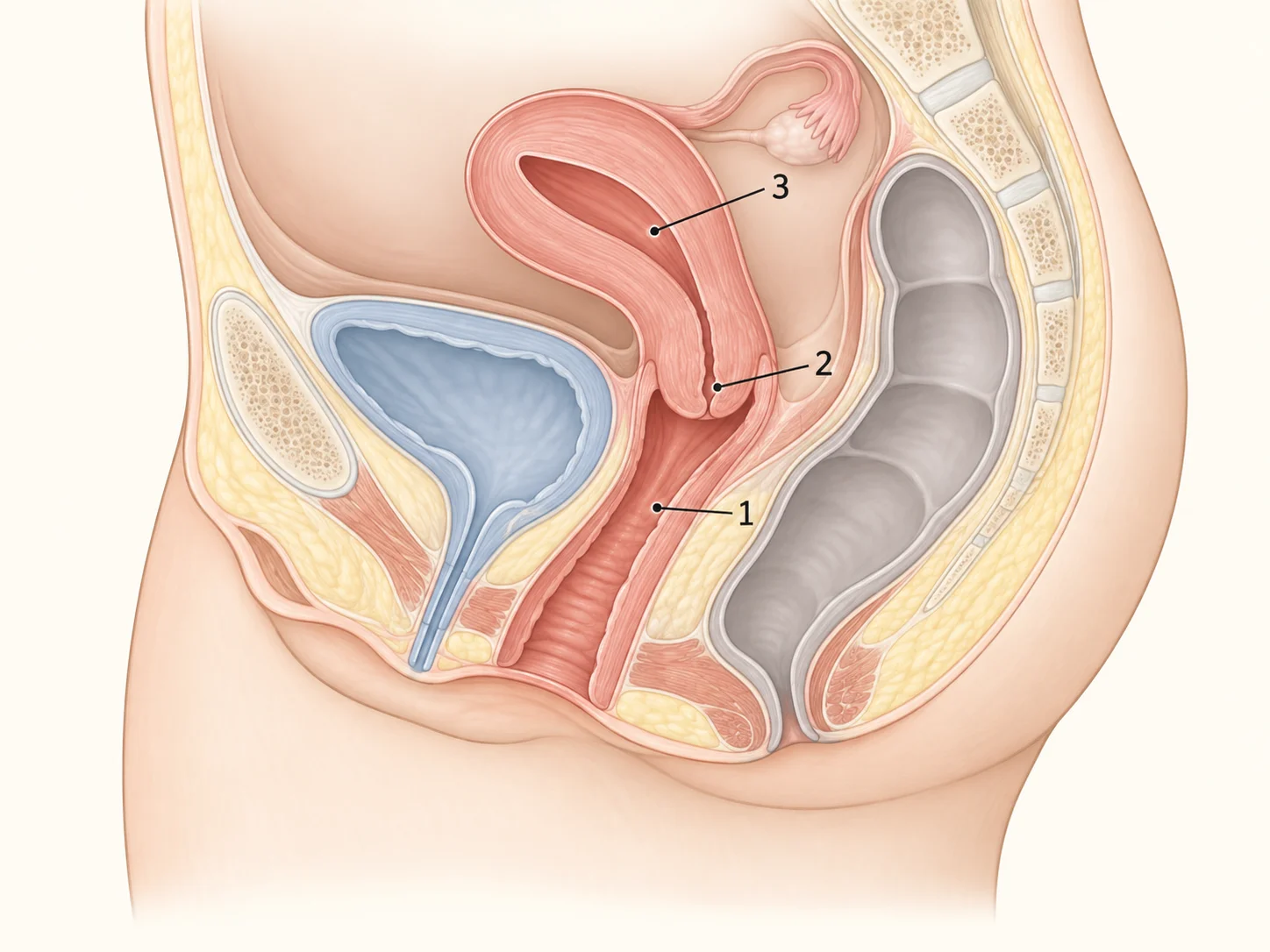
This position also helps explain a common misunderstanding: the vagina is not a permanently open cavity with a fixed diameter. Its walls and the surrounding tissue adjust to pressure and movement. An overview in German is available from the Institute for Quality and Efficiency in Health Care.
What changes during arousal
Sexual arousal increases blood flow in the genital area. The vagina usually becomes wetter, its upper section may widen, and the cervix and uterus rise slightly. This change in the upper vaginal space is often described as tenting. Levin, 2011: physiological changes during arousal
These changes can make more room for penetration. Their extent differs from person to person. The available descriptions do not support a reliable rule that every vagina increases by a set number of centimetres or always doubles in depth.
Time, touch that feels pleasant and freedom from pressure to perform can help. Arousal still does not guarantee painless sex: dryness, involuntary muscle tightening and other symptoms can occur even when you feel desire. Wetness by itself does not show that someone is comfortable with a particular depth. More foreplay is not a general cure for pain.
How does a longer penis fit inside?
The vagina can become longer and wider, and the entire penis is not inserted with every movement. For example, a penis that is 15 centimetres long and a much shorter vaginal measurement at rest are not contradictory. However, comparing those lengths does not establish that full penetration must feel comfortable for every body.
What matters is the location and amount of pressure. Deep penetration can touch or put pressure on the cervix and the areas around it. Some people find this pleasant; others find it uncomfortable or painful. Choosing less depth is a normal adjustment, not evidence that something is wrong with either person's body. Cleveland Clinic: the cervix and touch during sex
If only deep movements hurt, shallower movements, a different angle or a position where you control the depth may help. Recurrent deep pain can also be associated with inflammation, endometriosis or a tense pelvic floor and should be examined.
How wide is the vagina?
One number is even less useful for width than for length. The canal is not equally wide throughout, and its walls have folds. An MRI study of 80 women found considerable differences in shape and width between participants and between different sections of the same vagina. Height, weight and other recorded characteristics explained only a small part of these differences. Luo et al., 2016
A distance measured on a scan is therefore not an appropriate sizing guide for a penis, sex toy or tampon. What matters is what feels pleasant without uncomfortable pressure or pain. The visible vaginal opening does not measure the entire internal width either.
An individual's vaginal depth or width cannot be reliably predicted from height or the appearance of the labia. A person of short stature does not automatically have a short vagina, and large labia do not mean a wide vaginal canal.
Why the vagina can feel too tight
If penetration is difficult or there is burning at the entrance, the vagina is not necessarily anatomically too small. Dryness increases friction. The pelvic floor can also tighten involuntarily, making even a finger, tampon or examination uncomfortable. This pattern may fit vaginismus. It is not intentional and cannot simply be stopped through willpower. NHS: vaginismus
Other possible causes include irritated skin, infections and other medical conditions. If even light touch at the entrance is painful, the distance to the cervix does little to explain it. A perceived lack of depth and a painful vaginal entrance are different issues.
Forcing penetration or attempting painful stretching on your own does not resolve the cause. If the problem recurs, a gynaecological examination is sensible. Depending on the findings, focused pelvic floor physiotherapy and sex therapy may help, among other options.
What can explain a feeling of too much looseness
A change in how wide or loose the vagina feels also deserves a factual explanation. Pregnancy, childbirth, age and pelvic floor changes can affect sensations of support and contact. Some people feel less friction or notice a different bodily sensation than before. This does not make the body inferior or automatically indicate a condition.
If there is also downward pressure, a bulge at the vaginal opening or urine leakage, the pelvic floor should be assessed. A feeling of looseness and pelvic organ prolapse are different, but can raise similar concerns. Cleveland Clinic: changes in vaginal support and sensation
Exercises should address the actual issue. Training may help with reduced strength; when there is pain and excessive tension, relaxation and coordination are also important. Advising everyone to keep squeezing harder is not sound general advice.
Does frequent sex widen the vagina permanently?
No. Vaginal sex does not permanently widen the vagina, and its width cannot reveal how many sexual partners someone has had. The tissue can stretch and return to its resting state after temporary expansion. International Society for Sexual Medicine: sex and vaginal size
Changes caused by childbirth, injuries, hormonal shifts or illness need to be distinguished from this myth. A new sensation that persists should not be explained through sexual myths or dismissed simply because the vagina is elastic. Symptoms matter even if a judgemental explanation for them is wrong.
What childbirth, menopause and surgery may change
After childbirth, the entrance, pelvic floor and tissue can feel different. Healing, scars and muscle control all play a role, as does your own experience. Breastfeeding can also be associated with dryness. When you want to have sex again, healing and comfort matter more than comparisons with your body before childbirth.
During menopause, lower oestrogen levels can make the vaginal lining drier and more sensitive. Penetration may feel tighter or cause burning, even though the underlying issue lies in the tissue. Lubricants can reduce friction; if symptoms continue, suitable treatments can be discussed with a doctor. NHS: vaginal dryness
Removal of the uterus, called a hysterectomy, and other pelvic operations can also change the anatomy. In a clinical study of 3,247 women, age, menopause and previous procedures were associated with differences in measured vaginal depth. The researchers considered the differences unlikely to be clinically significant overall. These group comparisons cannot predict how one individual will feel after a procedure, though. Following an operation, the particular procedure, healing and your treatment team's instructions matter. Tan et al., 2006: factors associated with vaginal depth
Does size tell us anything about pleasure or good sex?
Vaginal length or width cannot be used to rank sexual satisfaction. A study involving 505 women aged 40 and above found no clinically meaningful relationship between measured vaginal dimensions and sexual function within the observed size ranges. Participants were patients from gynaecology and urogynaecology practices. These findings cannot simply be applied to every age group or to rare anatomical differences. Study of vaginal measurements and sexual function
Pleasure is not limited to depth. The clitoris is a central organ of sexual pleasure, and the kind of touch a person enjoys is individual. Some prefer internal pressure, others external stimulation or a combination. IQWiG: the clitoris and sexual arousal
Pay attention to the touch that feels good to you. Deeper penetration or a tighter sensation does not automatically mean more pleasure. Strong tension may even make contact uncomfortable.
Myths and facts about vaginal size
- Myth: A normal vagina is no more than ten centimetres deep.
- Fact: The commonly mentioned 7 to 10 centimetres is a rough range at rest. Different measurement paths give different values. It is not a health cutoff or the greatest possible depth of penetration.
- Myth: Arousal always doubles the depth.
- Fact: The upper vaginal space may expand and the cervix may rise. The extent differs between people. There is no reliable doubling rule.
- Myth: Frequent sex makes the vagina permanently wider.
- Fact: Sex does not leave lasting widening that reveals its frequency or the number of partners. Changes caused by birth, injury or illness are separate issues.
- Myth: Every vagina stays too wide after childbirth.
- Fact: Childbirth may affect the tissue and pelvic floor, but healing and symptoms vary. A lasting feeling of pressure or looseness can be assessed. Suitable help depends on the findings.
- Myth: The tighter the vagina, the better the sex.
- Fact: Width is not a measure of pleasure. Dryness or muscle tension can also create tightness. Pleasant touch, a suitable depth and absence of pain are more useful than an ideal of tightness.
- Myth: Body height reveals vaginal depth.
- Fact: Body measurements explain only a limited part of the differences. Height or the appearance of the labia cannot reliably tell you what will feel comfortable during penetration.
- Myth: If it hurts, the only issue is insufficient arousal.
- Fact: Dryness, infections, endometriosis or a tense pelvic floor can cause pain even when desire is present. More foreplay may help but does not replace assessment of recurring symptoms.
What you can try when penetration is uncomfortable
When something becomes uncomfortable, pause first. You can then work together to adjust whatever causes pressure or friction instead of trying to reach a supposedly correct depth.
- Allow more time for touch you actually enjoy. Penetration does not need to be the goal.
- For dryness, use a suitable lubricant, such as a water-based product. Check that it is compatible with condoms and sex toys.
- Reduce the speed and depth and try a different angle. Choose a position where you can control penetration depth.
- Notice whether there is burning at the entrance or pain only deeper inside. Timing, bleeding and dryness are also useful details for a medical appointment.
- Stop attempts that hurt. Repeatedly tolerating pain is not a reliable way to become used to penetration.
For example, if contact at the entrance feels pleasant but deeper movements cause sharp pain, more lubricant or stretching is not automatically needed. Try less depth first. If burning begins with the initial contact, friction, skin irritation or tension are other possibilities. This is a starting point for discussion, not a self-diagnosis.
These steps may make contact more comfortable but do not replace assessment when pain continues. See Pain during or after sex for more guidance. NHS physiotherapy: causes of pain in the genital area; Cambridge University Hospitals: pain and intimacy
Can or should I measure vaginal depth myself?
You do not need to measure your vagina to know whether your body is normal. Feeling the cervix with a finger can give a rough idea of its position. It is only a snapshot, however, not a reliable way to measure total vaginal depth. Its position and firmness also change during the menstrual cycle; around ovulation, the cervix is often harder to reach. Cleveland Clinic: changes in the cervix
Even studies give different results depending on the distance measured. A small MRI study of 28 women found an average distance of about 6.3 centimetres from the cervix to the vaginal entrance. In another MRI study involving 80 women, the front and back vaginal walls averaged about 6.3 and 9.8 centimetres, respectively. These are different measurement paths, not conflicting standards for your body. Barnhart et al., 2006; Luo et al., 2016
If you have symptoms, their description is more helpful than a measurement you take yourself: where it hurts, when it began, whether pain changes through the cycle, and whether bleeding, discharge or dryness occurs as well. When a measurement is medically relevant, it can be taken during a focused examination.
When to seek medical help
Arrange a gynaecology appointment if pain keeps recurring, penetration is hardly possible or a change in how your vagina feels does not go away. Bleeding after sex, unusual discharge, continued dryness and new pressure or downward sensations should also be assessed. The examination aims to identify the cause and enable suitable treatment.
Severe or suddenly worsening lower abdominal pain, heavy bleeding, fainting or marked dizziness need prompt medical help. Lower abdominal pain with fever or a possible pregnancy also requires urgent medical attention. NHS: warning signs with pelvic pain
Conclusion
The vagina is often about 7 to 10 centimetres long at rest, but it is not restricted to a fixed penetration depth. Arousal, tissue, the pelvic floor and angle jointly influence what feels comfortable. Neither very deep penetration nor a particularly tight feeling proves that sex is good. Adjusting speed and depth and taking pain seriously are more useful than any comparison of sizes.
Read further
More on anatomy and possible causes of pain during penetration.