Nominal width for condoms: How to find the right size without a calculator
Nominal width is the most reliable number on a condom pack when you want to compare fit properly. It tells you in millimetres how wide a condom is when laid flat. If you measure your girth, roughly halve it, and then check the fit signs, you can usually find the right size faster than by depending on labels such as Standard or XL.


What nominal width means?
Nominal width is the millimetre measurement for the width of a condom when it is laid flat. It is not your body width and it is not a diameter. That is exactly why it is so useful for choosing size: it lets you compare products even when the pack only says Standard, Regular, Large, or XL.
If you pay attention to that number, you can judge much more reliably across brands whether a condom is likely to feel secure, too tight, or likely to slip. For size comparison, the millimetre measurement is almost always more useful than a marketing label.
Why Standard and XL often do not help much?
Many people buy condoms by instinct and reach for Standard or XL. The problem is simple: those labels are not standardised. Two products can carry the same label and still feel noticeably different. Nominal width gives you a common point of comparison.
For latex condoms, there are also established testing standards such as ISO 4074. That standard does not tell you which size fits you, but it does show that condoms are tested against fixed requirements. ISO: ISO 4074 Natural rubber latex male condoms
Nominal width explained visually
The number feels abstract until you see what it refers to. It means the width of the condom when it is lying flat. That also makes it easier to understand why moving from measured girth to a practical starting point is fairly straightforward.
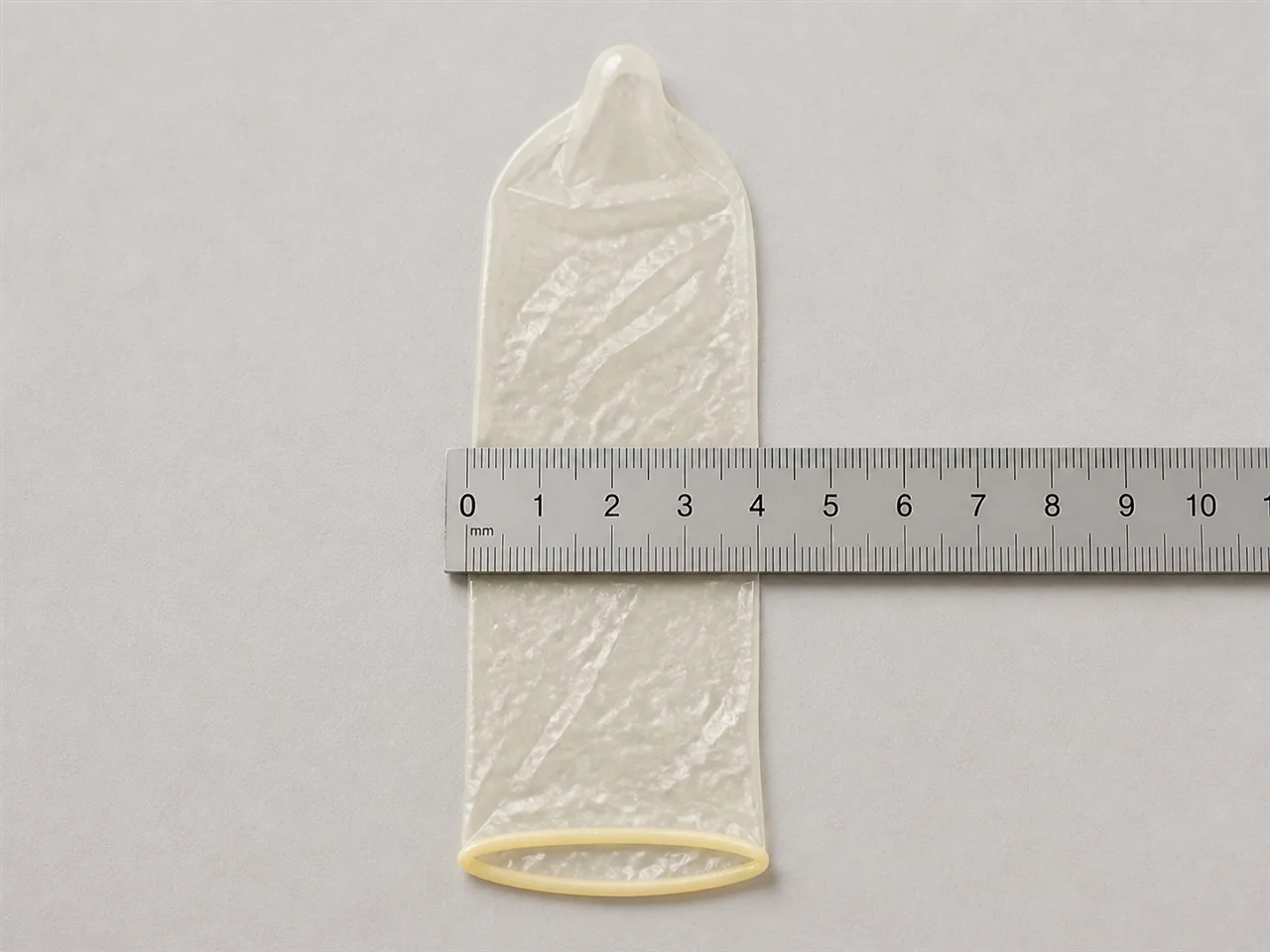
You do not need to measure condoms yourself. The image is only there to show what the number describes and why it is more useful for size choice than a vague size label.
Do you actually need a calculator for this?
Many people look for a calculator or a formula because the number on the pack sounds technical at first. In practice, the question is usually much simpler: which millimetre width is a sensible starting point without spending too much time on charts and maths?
In most cases, you do not need a tool. A clean girth measurement, a rough halving step, and a short real-world fit test will get you further than any rigid chart.
How to measure your girth properly?
Measure while erect. A flexible measuring tape is ideal. If you do not have one, a strip of paper or a piece of string also works, as long as you read it afterwards on a ruler in millimetres.
- Measure at mid-shaft or at the widest point.
- Measure snugly, but do not dig into the skin.
- Repeat the measurement on two different days and use the typical value.
For condom fit, girth is almost always more important than length. If you also want to understand how width, length, and shape work together, our guide to condom sizes is a useful follow-up.
The simple conversion without a calculator
If you measured your girth in millimetres, you get a good starting point for nominal width by roughly dividing that number by two. That fits the logic of a condom lying flat and works surprisingly well as a first estimate.
- Starting point: divide girth in millimetres by two
- Example: 104 millimetres of girth gives about 52 millimetres nominal width
- Example: 112 millimetres of girth gives about 56 millimetres nominal width
This is deliberately a starting point, not a law of nature. Material, stretch, shape, and erection changes affect how it feels. That is why the real decision always comes from actual fit signs.
Typical width ranges as a guide
Many people want to know what counts as normal or average. There is no single standard size, but certain ranges appear much more often in shops. Use them as a rough map, not as a label you have to match.
- 47 to 49 millimetres: very narrow to narrow
- 50 to 52 millimetres: narrow to medium
- 53 to 54 millimetres: medium
- 55 to 56 millimetres: medium to wide
- 57 to 60 millimetres: wide
- 61 millimetres and above: very wide
Even 1 to 2 millimetres can feel noticeably different. If you land between two widths, that is normal and not a sign that you measured incorrectly.
How a good fit should feel?
A condom that fits well rolls down to the base without a fight, stays secure there, and looks smooth on the shaft rather than wrinkled or loose. It should not roll back on its own, move forward, or feel like a tight ring.
Correct use matters too. Key basics are: put it on before contact, pinch the tip, roll it all the way down, and hold the rim when withdrawing. CDC: Condom Use NHS: Condoms
Clear signs that it is too small or too large
How to tell when a condom is too small
Typical signs are strong constriction, pressure, numbness, difficulty rolling it down, or the sense that the erection fades faster. If that happens more than once, trying one width larger is usually the most sensible first step.
How to tell when a condom is too large
Typical signs are wrinkles, an unstable fit, sliding forward, or slipping during position changes. If this happens repeatedly, trying one width smaller is often the quickest fix, provided the condom is rolled fully to the base.
Why condoms tear or slip even when they are new?
Often it is not about age or freshness, but about a combination of fit, friction, and use. Too tight means more tension and often more friction. Too loose means more movement, folds, and mechanical stress. Common mistakes like trapped air in the tip, opening damage, or putting it on too late also matter.
If that keeps happening, it makes sense to check size and use step by step. Major health sources give very similar basics for safer condom use. WHO: Condoms If you need a concrete plan after a mishap, our article on a torn or slipped condom walks you through it.
How to think about lube and material?
Lube can improve comfort and safety, especially with dryness, longer sex, or sensitive tissue. But it does not solve a sizing problem. If a condom slips, width is often the first thing to check. If it burns or quickly feels uncomfortable, friction, material, or additives may also play a role.
With latex, oil-based products can also weaken the material. If you often notice burning, irritation, or uncertainty about materials, our article on latex-free versus latex is the next useful read.
Are condom sizes the same worldwide?
The millimetre measurement gives you the best chance of comparing sizes, but shop selection still differs a lot from country to country. Some markets lean narrower, others wider, and the wording on the pack often stays deliberately vague. In India, the millimetre number is usually the clearest guide when the pack only uses broad labels like Standard or XL.
- When shopping abroad, look for the millimetre width first, not XL.
- If there is no millimetre width on the pack, comparison becomes much harder.
- If in doubt, testing two neighbouring widths is more helpful than guessing from a label.
Myths and facts about nominal width
- Myth: Standard is a real size. Fact: Standard is only a label without a fixed millimetre definition.
- Myth: Nominal width is a diameter. Fact: It means the width of the condom when laid flat.
- Myth: Length is the main problem. Fact: For fit, girth is usually much more important.
- Myth: If it slips, more lube will fix it. Fact: Lube helps with friction, but slipping is often a width or fit issue.
- Myth: If it tears, the brand must be bad. Fact: Common reasons are too tight or too loose a fit, friction, and handling mistakes.
- Myth: Two condoms are safer than one. Fact: More friction between layers can increase the risk instead.
A quick practical plan: find the right width in two tests
Measure your girth in millimetres and halve it. Use that as your starting point, then test exactly two widths: your starting point and one neighbouring size. If it slips or wrinkles, go smaller. If it pinches, constricts, or causes numbness, go larger. This usually gets you to a better fit faster than guessing from the front of the pack.
Conclusion
Nominal width is the most useful comparison number for condoms. Measure your girth, halve it as a starting point, and then decide based on real fit signs instead of labels such as Standard or XL. That is usually the fastest route to a condom that feels secure and comfortable.
You may also want to read
Here are three related articles if you want to take the topic forward in a more practical way.