How deep is the vagina? What's normal and what matters during sex
At rest, the vagina is often about 7 to 10 centimeters long. A longer penis can still fit comfortably: the canal stretches, changes shape during arousal, and does not have to accommodate the entire penis. What matters is not just a number, but how depth, pressure, and touch feel. Recurring pain deserves evaluation even when measurements fall within the usual range.


At a glance
- Resting length and comfortable penetration depth are different things. A measurement in centimeters does not decide what has to fit during sex.
- Arousal can create more room in the upper vagina; a fixed doubling in depth does not apply to everyone.
- Tightness at the entrance, friction, and deep pressure can have different causes and call for different adjustments.
- Frequent sex does not permanently widen the vagina. Its width cannot reveal someone's sexual history.
- Recurring pain, bleeding, or new feelings of pressure should be checked by a gynecologist.
How deep is the vagina in centimeters?
As a rough guide, Cleveland Clinic describes the unaroused vagina as about 7 to 10 centimeters long. This refers to the internal canal from the vaginal opening to the area around the cervix. It is not a target measurement: a shorter or longer measurement alone does not mean there is a medical problem. Cleveland Clinic: vaginal anatomy
How, then, can sex with a longer penis work? The measurement describes a resting state. The vaginal walls can move, and the shape, tension, and position of surrounding structures change during sex. A penis also does not need to be inserted all the way.
A length measurement is therefore neither an upper limit nor a goal you need to reach. There is no number of centimeters that automatically makes sex good, bad, or painful.
Where the vagina sits and why it is not a straight tube
The vagina sits in the pelvis between the bladder and rectum. It angles upward and backward, with the cervix projecting into its upper end. The small opening in the cervix leads to the uterus. During vaginal sex, a penis stays in the vagina and does not pass through the cervix into the uterus.
The external genitals are called the vulva. They include the labia and the visible part of the clitoris. The appearance of the vulva does not tell you how long or wide the internal canal is. For more on the distinction, see Vulva and vagina.
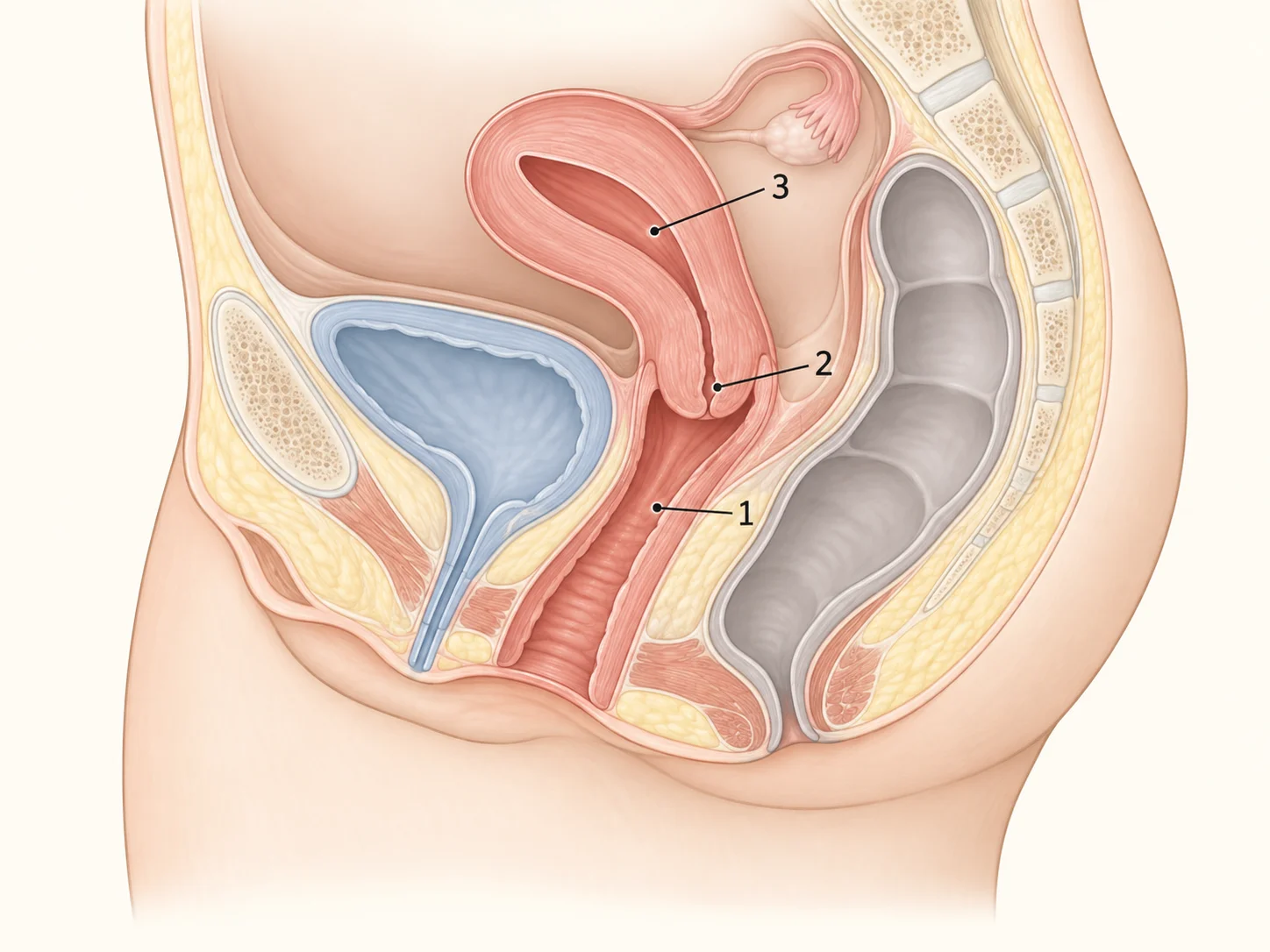
This arrangement also helps explain a common misconception: the vagina is not a permanently open space with a fixed diameter. Its walls and the surrounding tissue respond to pressure and movement. A German-language overview is available from the Institute for Quality and Efficiency in Health Care.
What changes during arousal
Sexual arousal increases blood flow to the genital area. The vagina usually becomes wetter, the upper part can expand, and the cervix and uterus lift slightly. This change in the upper vaginal space is often called tenting. Levin, 2011: a physiological account of changes during arousal
This can create more room for penetration. How noticeable the change is varies from person to person. The available descriptions do not establish a reliable rule that every vagina grows by a particular number of centimeters or always doubles in depth.
Time, pleasurable touch, and freedom from performance pressure can help. Arousal still does not guarantee pain-free sex: dryness, involuntary muscle tension, or other symptoms can occur even when you feel desire. Wetness alone does not prove that someone is comfortable with a particular depth. More foreplay is therefore not a universal treatment for pain.
How can a longer penis fit?
The vagina can lengthen and widen, and not every movement involves inserting the full length of the penis. A penis measuring, for example, 15 centimeters and a much shorter measurement of the vagina at rest are therefore not contradictory. But comparing the lengths does not mean that full penetration must feel comfortable for every body.
What matters is where pressure occurs and how much there is. Deep penetration can touch or put pressure on the cervix and surrounding areas. Some people enjoy this; others find it uncomfortable or painful. Using less depth is a normal adjustment, not a sign that something is wrong with either person's body. Cleveland Clinic: the cervix and touch during sex
If only deep movements hurt, shallower movements, a different angle, or a position that lets you control depth may help. Recurring deep pain can also be related to inflammation, endometriosis, or a tense pelvic floor and should be evaluated.
How wide is the vagina?
A single number is even less useful for width than for length. The canal is not equally wide throughout, and its walls have folds. In an MRI study involving 80 women, shape and width differed substantially both between participants and between sections of the same vagina. Height, weight, and other recorded characteristics explained only a small part of those differences. Luo et al., 2016
A distance measured on an image is therefore not a suitable sizing guide for a penis, sex toy, or tampon. What matters is what feels good without uncomfortable pressure or pain. The visible vaginal opening is not a measure of the entire internal width either.
Height and the appearance of the labia also cannot reliably predict an individual's vaginal depth or width. A shorter person does not automatically have a short vagina, and large labia do not mean a wide vaginal canal.
Why the vagina can feel too tight
If penetration is difficult or the entrance burns, the vagina is not necessarily anatomically too small. Dryness increases friction. The pelvic floor can also tighten involuntarily, making even a finger, tampon, or examination uncomfortable. This pattern can be consistent with vaginismus. It is not intentional and cannot simply be stopped by trying harder. NHS: vaginismus
Other possible causes include irritated skin, infections, and other conditions. If even light touch at the entrance hurts, the distance to the cervix does little to explain the problem. A perceived lack of depth and a painful vaginal entrance are two different issues.
Forcing penetration or attempting painful stretching on your own does not address the cause. If the problem keeps returning, a gynecological examination makes sense. Depending on the findings, targeted pelvic floor physical therapy and support from a sex therapist may help, among other options.
What can cause a feeling of too much looseness
A change in how loose the vagina feels also deserves a clear, factual response. Pregnancy, childbirth, age, and pelvic floor changes can affect how support and contact feel. Some people notice less friction or a different bodily sensation than before. That does not make their body inferior, and it does not automatically mean there is a medical condition.
If there is also downward pressure, a bulge at the vaginal opening, or urine leakage, the pelvic floor should be examined. A feeling of looseness and pelvic organ prolapse are not the same thing, but they can prompt similar concerns. Cleveland Clinic: changes in vaginal support and sensation
The right exercises depend on the actual issue. Training may be useful when strength is reduced; pain and excessive tension also call for relaxation and coordination. Telling everyone to squeeze harder is therefore not good general advice.
Does frequent sex permanently widen the vagina?
No. Vaginal sex does not permanently widen the vagina, and its width cannot tell you how many sexual partners someone has had. The tissue stretches and can return to its resting state after temporary stretching. International Society for Sexual Medicine: sex and vaginal size
Changes caused by childbirth, injuries, hormonal shifts, or medical conditions are a different matter. A new, persistent change in sensation should not be explained with sexual myths or dismissed by saying that the vagina is elastic. Symptoms matter even when a judgmental explanation for them is wrong.
What childbirth, menopause, and surgery can change
After childbirth, the entrance, pelvic floor, and tissue can feel different. Healing, scars, and muscle control all play a role, as does your own experience. Breastfeeding can also be associated with dryness. When you want to have sex again, healing and comfort matter more than comparing your body with how it was before birth.
During menopause, lower estrogen levels can make the vaginal lining drier and more sensitive. Penetration may then feel tighter or cause burning, even though the underlying issue is in the tissue. Lubricants can reduce friction; if symptoms persist, you can discuss suitable treatments with a clinician. NHS: vaginal dryness
Removal of the uterus, called a hysterectomy, and other pelvic operations can also change the anatomy. In a clinical study of 3,247 women, age, menopause, and previous procedures were associated with differences in measured vaginal depth. The researchers considered these differences unlikely to be clinically significant overall. However, comparisons between groups cannot predict how an individual will feel after a procedure. After surgery, the particular procedure, healing, and your care team's instructions are what matter. Tan et al., 2006: factors associated with vaginal depth
Does size tell you anything about pleasure or good sex?
Vaginal length or width cannot tell you how sexually satisfied someone is. A study of 505 women aged 40 and older found no clinically meaningful relationship between measured vaginal dimensions and sexual function within the observed size ranges. The participants were patients in gynecology and urogynecology practices. The results cannot automatically be applied to every age group or to rare anatomical differences. Study of vaginal dimensions and sexual function
Pleasure is also not limited to depth. The clitoris is a central organ of sexual pleasure, and which touch feels good varies by person. Some prefer internal pressure, others external stimulation, or a combination. IQWiG: the clitoris and sexual arousal
Pay attention to the kinds of touch you enjoy. Deeper penetration or a tighter feeling does not automatically mean more pleasure. Strong tension can even make contact uncomfortable.
Myths and facts about vaginal size
- Myth: A normal vagina is no more than ten centimeters deep.
- Fact: The commonly quoted 7 to 10 centimeters is a rough resting range. Different measurement paths give different results. The number is neither a health cutoff nor the maximum possible penetration depth.
- Myth: Arousal always doubles vaginal depth.
- Fact: The upper vaginal space can expand and the cervix can lift. The amount varies between people. There is no reliable doubling rule.
- Myth: Frequent sex makes the vagina permanently wider.
- Fact: Sex does not leave permanent widening that reveals how often someone has sex or how many partners they have had. Changes caused by birth, injury, or illness are separate issues.
- Myth: Every vagina stays too loose after childbirth.
- Fact: Birth can change tissue and the pelvic floor, but healing and symptoms vary. Persistent feelings of pressure or looseness can be evaluated. Appropriate help depends on the findings.
- Myth: The tighter the vagina, the better the sex.
- Fact: Width does not measure pleasure. Tightness can also result from dryness or muscle tension. Pleasant touch, comfortable depth, and absence of pain are more useful than an ideal of tightness.
- Myth: A person's height reveals their vaginal depth.
- Fact: Body measurements explain differences only to a limited extent. Height or the appearance of the labia cannot reliably tell you what will feel comfortable during penetration.
- Myth: If it hurts, the only problem is insufficient arousal.
- Fact: Dryness, infections, endometriosis, or a tense pelvic floor can cause pain even when desire is present. More foreplay may help, but it does not replace evaluation of recurring symptoms.
What to try when penetration feels uncomfortable
If something becomes uncomfortable, pausing is the first useful step. You can then work together to change what causes pressure or friction, instead of trying to achieve a supposedly correct depth.
- Allow more time for touch you actually enjoy. Penetration does not have to be the goal.
- For dryness, use a suitable lubricant, such as a water-based one. Check compatibility with condoms and sex toys.
- Reduce speed and depth and try a different angle. Choose a position that lets you control penetration depth.
- Notice whether there is burning at the entrance or pain only deeper inside. Timing, bleeding, and dryness are also useful details to share at a medical appointment.
- Stop attempts that hurt. Repeatedly enduring pain is not a reliable way to get used to penetration.
For example, if contact at the entrance feels pleasant but deeper movements cause a stabbing pain, you do not automatically need more lubricant or more stretching. Try less depth first. If it burns right from the first contact, friction, skin irritation, or tension are other possibilities to consider. This is a starting point for a conversation, not a self-diagnosis.
These steps may make contact more comfortable, but they do not replace evaluation of persistent pain. For more guidance, see Pain during or after sex. NHS physical therapy: causes of genital pain; Cambridge University Hospitals: pain and intimacy
Can or should I measure my own vaginal depth?
You do not need to measure your vagina to know whether your body is normal. Feeling the cervix with a finger can give a rough sense of its position. But it is a snapshot, not a reliable measurement of total vaginal depth. Position and firmness also change during the menstrual cycle; around ovulation, the cervix is often harder to reach. Cleveland Clinic: changes in the cervix
Even in studies, the result depends on which distance is measured. A small MRI study involving 28 women found an average of about 6.3 centimeters from the cervix to the vaginal entrance. In another MRI study of 80 women, the front and back vaginal walls averaged about 6.3 and 9.8 centimeters, respectively. These are different measurement paths, not contradictory rules for your body. Barnhart et al., 2006; Luo et al., 2016
If you have symptoms, describing them is more useful than a number you measured yourself: where it hurts, when it started, whether pain changes during the cycle, and whether bleeding, discharge, or dryness also occurs. If a measurement is medically relevant, it can be taken specifically during an examination.
When to seek medical help
Make a gynecology appointment if pain keeps returning, penetration is barely possible, or you notice a lasting change in how your vagina feels. Bleeding after sex, unusual discharge, ongoing dryness, and new feelings of pressure or downward heaviness should also be checked. The examination aims to identify the cause and make suitable treatment possible.
Severe or suddenly worsening lower abdominal pain, heavy bleeding, fainting, or marked dizziness require prompt medical help. Lower abdominal pain with fever or a possible pregnancy also needs urgent medical attention. NHS: warning signs with pelvic pain
Conclusion
At rest, the vagina is often about 7 to 10 centimeters long, but that does not limit it to a fixed penetration depth. Arousal, tissue, the pelvic floor, and angle all help determine what feels comfortable. Neither especially deep penetration nor a particularly tight feeling proves that sex is good. Being able to adjust speed and depth and taking pain seriously are more useful than any size comparison.
Keep reading
More on anatomy and possible causes of pain during penetration.