COVID‑19 vaccination and male fertility: Can it make you infertile?
Can a COVID‑19 vaccine make men infertile, change sperm, or mean you should postpone trying for a baby? This article takes those concerns seriously, examines the studies, and explains what really matters for your own lab results and for donor sperm.


The short, honest answer
The fear that a COVID‑19 vaccine could sterilize men has proved remarkably persistent. Research published so far does not provide solid evidence for that claim. Studies comparing men before and after vaccination found no lasting deterioration in the usual semen parameters. Among couples trying to conceive, vaccination was not linked to a lower chance of pregnancy either.
That does not guarantee that no value will ever change in an individual. Semen analysis results fluctuate anyway, and fever can temporarily disrupt sperm production. This is precisely why three things need to be kept separate: vaccination, a vaccine reaction involving fever, and a SARS‑CoV‑2 infection. They are not biologically identical, and the data do not treat them as identical.
- Vaccination status is not a seal of quality for semen.
- An abnormal semen analysis after vaccination does not by itself prove a cause.
- Fever and acute infections must be placed in their time context when a semen analysis is interpreted.
- For donor sperm, laboratory values, infection screening, documentation, and traceability matter more than a vaccinated or unvaccinated label.
This article answers the fertility question. It does not decide whether another COVID‑19 vaccination is right for you personally. That depends on factors including age, underlying conditions, and current recommendations. The guidance from the Robert Koch Institute and advice from your own clinician are better resources for that decision.
Why the fear of infertility is so persuasive
Fertility is not something you can directly feel. Months may pass between a suspected cause and a pregnancy that does not happen. At the same time, semen values vary even in healthy men. That makes the subject vulnerable to simple explanations: a poor result after vaccination can feel like proof, although one event following another does not establish causation.
Several fears converged during the pandemic. One claim said that antibodies against the spike protein might also attack syncytin‑1, a protein important to the placenta, because of a supposed similarity. Another said vaccine mRNA could change the DNA of germ cells. Neither idea is supported by known biological mechanisms or observed fertility data. The RKI explains the fertility myth in detail; the CDC overview of how vaccines work clearly explains why vaccine mRNA does not enter the cell nucleus.
People who have this concern are not automatically hostile to science. They are often looking for an understandable answer to a deeply personal question. A good answer can take that fear seriously while still distinguishing a hypothesis, an individual case, and a reliable signal.
What about other vaccines?
The detailed semen studies discussed in this article concern COVID‑19 vaccines. Their findings cannot simply be transferred to every other vaccine: a measles, influenza, HPV, or tetanus vaccine is not the same product under a different name. The evidence, vaccine type, and recommendations must be considered for the specific vaccine in question.
Even so, there is no solid basis for the blanket claim that vaccines make people infertile. The RKI points to studies of different vaccines and finds no effect on fertility. Recommendations around pregnancy can still differ by vaccine. That is a question of timing and protection against a particular illness, not automatically a sign of damaged sperm.
If you are unsure about a specific vaccination during fertility treatment, tell the treatment team the exact vaccine, the date, and any reactions such as a high fever. That information is more useful than asking whether vaccines in general are good or bad for sperm.
Semen quality is not the same as fertility
Most vaccine studies do not directly measure whether a man can later father a child. They mainly compare values from a semen analysis:
- Volume: the amount of ejaculate;
- Concentration: the number of sperm per milliliter;
- Total count: the number of sperm in the whole ejaculate;
- Motility: how many sperm move and move forward;
- Morphology: the proportion that meets the shape criteria examined;
- Additional markers: depending on the question, DNA fragmentation, for example.
These values matter, but no single one draws a hard line between fertile and infertile. The European Association of Urology guideline describes semen parameters as surrogate measures and recommends assessing the reproductive potential of both people together. A natural pregnancy can occur despite an abnormal individual value; conversely, an unremarkable semen analysis does not guarantee pregnancy.
The sample itself also has a history. Abstinence time, incomplete collection, transport, medication, an infection, fever, and natural biological variation can all affect the result. A single report is therefore one data point, not a judgment on masculinity and not a final fertility certificate.
What the research now shows
The reassuring overall conclusion does not depend on one study. Several research groups compared semen samples from the same men before and after vaccination. In an early study of 45 men and another of 101 men, concentration, motility, and total count did not deteriorate to a relevant degree (Gonzalez et al., 2021; Massarotti et al., 2022).
A study of 2,126 couples comes even closer to the actual fertility question. It examined not only laboratory values but also the chance of pregnancy in each cycle. Vaccination of either partner was not associated with a lower probability of conception (Wesselink et al., 2022).
Systematic reviews bring this pattern together and find no adverse effect on the semen parameters studied (Huang et al., 2023). At the same time, many individual studies are small and use different methods. Another review therefore rates the quality of the evidence as low (review of evidence quality). That does not make the findings worthless, but it does rule out absolute promises.
One study found a different pattern
A small retrospective study of 37 sperm donors reported lower sperm concentration and total motile count 75 to 125 days after the second BNT162b2 dose. More than 145 days after vaccination, the values had recovered; volume and motility were not impaired (Gat et al., 2022).
This observation should neither be hidden nor inflated into a report of sterility. The group was small, there was no unvaccinated control group followed in parallel, and the signal was temporary. It therefore does not support a claim of permanent infertility. It does, however, show why honest science does not need absolute zero-risk language: good interpretation includes data that do not fit the main pattern perfectly.
What we know and what remains uncertain
The mRNA vaccines used during the first years of the pandemic have been studied most extensively. There are also data on viral-vector and inactivated vaccines, but not the same amount for every platform, booster dose, combination, or rare underlying condition. Many studies followed healthy men for only a few months. Small before-and-after studies are inherently unable to detect very rare events.
Despite those limits, the overall picture is more informative than a collection of anecdotes: there is no consistent signal of lasting deterioration in common semen parameters, the probability of natural conception, or assisted-reproduction outcomes. The precise conclusion is not that every possible effect has been ruled out forever. It is that the available research does not show the claimed sterilization.
Vaccination, infection, and fever compared
- After vaccination
- Most before-and-after data show no clinically relevant, lasting deterioration. If a vaccine reaction includes a high fever, that fever can temporarily matter regardless of what caused it.
- After a SARS‑CoV‑2 infection
- The infection can cause fever and stronger systemic inflammation. In the study of couples by Wesselink and colleagues, infection in the male partner during the preceding 60 days was associated with a temporarily lower probability of conception; the signal was no longer visible later.
- After a fever from another cause
- This link predates COVID‑19. In a study using monthly samples from 27 healthy men, concentration, motility, and morphology were temporarily less favorable after febrile episodes. The severity and course differed markedly from person to person (Carlsen et al., 2003).
This also explains why timing matters. Sperm production and maturation take several weeks. An infection can therefore still appear in a semen analysis when you have long felt well again. This does not create an automatic three-month pause for sex, sperm donation, or fertility treatment. It simply means that a recent fever should be mentioned when the result is interpreted.
What does this mean for IVF, ICSI, and IUI?
Anyone in the middle of fertility treatment needs more than the reassurance that the average semen analysis remains normal. The important question is whether fertilization, embryo development, and pregnancy chances are worse. A systematic review of assisted-reproduction studies found mostly no statistically significant differences in ovarian response, embryo quality, implantation, or pregnancy outcomes (review of COVID‑19 vaccination and assisted reproduction).
One study examined 271 vaccinated male partners and 271 comparable unvaccinated partners after the inactivated CoronaVac vaccine. Fertilization rates, embryo development, implantation, and clinical pregnancy did not differ significantly. Some semen parameters fluctuated, but total motile sperm count remained comparable and all values stayed above the lower reference limits (Wang et al., 2022).
These data do not justify routinely postponing treatment solely because of a past vaccination. If vaccination or infection caused a high fever, or if a markedly impaired semen analysis is already known, the treatment team can decide whether an earlier sample, a later follow-up, or cryopreservation in a special situation makes sense. The age and time pressure of both people involved belong in that decision.
Does a donor’s vaccination status matter?
Wanting control is especially understandable when donor sperm is involved: the decision concerns not just a sample but the possible conception of a child. Vaccination status looks like a simple yes-or-no rule. Medically, however, it answers none of the questions that determine the quality and safety of the actual sample.
- How were concentration, total count, and motility measured?
- When was the sample produced in relation to fever, infection, and medication?
- What infection screening was performed, and how current is it?
- Are the medical and family histories understandable and complete?
- Are identity, consent, documentation, and traceability settled?
An unvaccinated donor can have excellent, average, or poor semen values, just like a vaccinated donor. You are free to ask about vaccination status and set personal boundaries. The problem begins when unvaccinated is sold as a medical seal of quality or used to justify a fantasy price. A label cannot replace a test.
The most common myths and questions
Many of these claims appear in search engines because people genuinely worry about them. They deserve clear answers, but not a separate heading for every sentence.
- Does COVID‑19 vaccination make men infertile?
- Cohort studies and reviews to date show neither lasting deterioration in common semen parameters nor a lower chance of conception due to vaccination. That is the most direct answer to the fear of sterility.
- Can vaccine mRNA change sperm DNA?
- Vaccine mRNA briefly supplies instructions in the cell cytoplasm and is then broken down. It does not enter the nucleus, where DNA is stored; the data do not show integration into sperm DNA.
- Do antibodies attack the fertility protein syncytin‑1?
- There is no solid evidence for the proposed cross-reaction. The claim is also inconsistent with observed pregnancies and fertility data after vaccination.
- Can the vaccine be passed on through semen or sex?
- No. Vaccination cannot be transmitted through sexual intercourse or contact with ejaculate. Antibodies may be measurable in body fluids after an immune response, but that is neither vaccine shedding nor indirect vaccination. A study of 86 men found no association between antibodies in seminal plasma and poorer semen parameters (Chillon et al., 2023).
- Is unvaccinated sperm healthier or more valuable?
- No, not because of that characteristic. The health and suitability of a sample follow from measurements, screening, origin, and context. Scarcity marketing does not change that.
- Should sperm be frozen as a precaution before vaccination?
- For healthy men, COVID‑19 vaccination alone creates no general need to do so. Cryopreservation before treatments known to threaten fertility, such as certain chemotherapy or radiation treatments, is important but is a different subject.
- Do you have to pause trying for a baby for three months after vaccination?
- The data do not support a blanket waiting period solely because of vaccination. After a high fever, a later semen analysis may give a more stable picture; when time matters, an early test followed by a repeat may make more sense than waiting blindly.
- Is a booster more harmful than the primary series?
- There is no consistent signal of lasting deterioration after an additional dose. The amount of data varies by vaccine, dose, and interval, so an isolated sequence in time should not become a general rule.
- Can vaccination affect libido, erections, or testosterone?
- Feeling unwell can temporarily affect desire and sexual activity. A lasting vaccine-related signal has not been established. A cross-sectional study found no increased risk of erectile dysfunction among vaccinated men aged 45 and older, although its design cannot safely rule out rare or long-term effects (Diaz et al., 2022).
How to plan a useful semen analysis
If you want clarity about your own sperm quality, a standardized semen analysis is more informative than drawing conclusions from a vaccination record. The WHO laboratory manual describes consistent procedures for collection and analysis. They include two to seven days of ejaculatory abstinence, collecting the sample as completely as possible, and controlled, prompt transport to the laboratory.
- Record fever, acute infections, and relevant medication with dates.
- Tell the laboratory if part of the sample was lost.
- When possible, compare follow-up tests performed under similar conditions.
- Have an abnormal finding confirmed instead of explaining it from one value.
- Discuss major deviations, azoospermia, or symptoms with an andrologist or urologist.
For more on preparation, laboratory values, and the limits of the test, read the RattleStork article Understanding your semen analysis.
What if the results are poor after vaccination or infection?
First, do not turn one sheet of paper into a lifelong diagnosis. Ask the laboratory or clinician whether the sample was complete, how long the abstinence period was, and whether fever, COVID‑19, another infection, new medication, or unusual strain occurred during the preceding weeks. A second semen analysis under comparable conditions can show whether the finding is stable.
A very low sperm count, no sperm, pain, swelling, or a palpable lump should not wait for months of observation. The same applies if fertility treatment is already under way or a factor affecting your partner creates time pressure. The goal is not to win a political argument but to make the best next decision for this particular attempt to have a child.
Supplements are not a quick answer to an unexplained finding either. Sleep, nicotine, alcohol, intense heat, anabolic steroids, excess weight, illness, and medication may all matter, but not every general tip fits every cause. Diagnose first, then make a targeted change.
Fun fact: “Unvaxxed sperm is the next Bitcoin”
Perhaps the strangest side story in the debate was the slogan on this sign. It was photographed at a demonstration against mandatory vaccination in Vienna on November 20, 2021. Memecoin projects later adopted the idea and marketed tokens with names such as Unvaxxed Seamen or Unvaxxed Sperm.
The joke treats unvaccinated sperm like a speculative asset that will supposedly become scarce. Medically, the Bitcoin logic does not hold up: vaccination status makes a semen sample neither automatically rare nor better. As a record of its time, however, the meme shows remarkably well how quickly a real health fear can turn into a protest symbol, clickbait, and a business model.
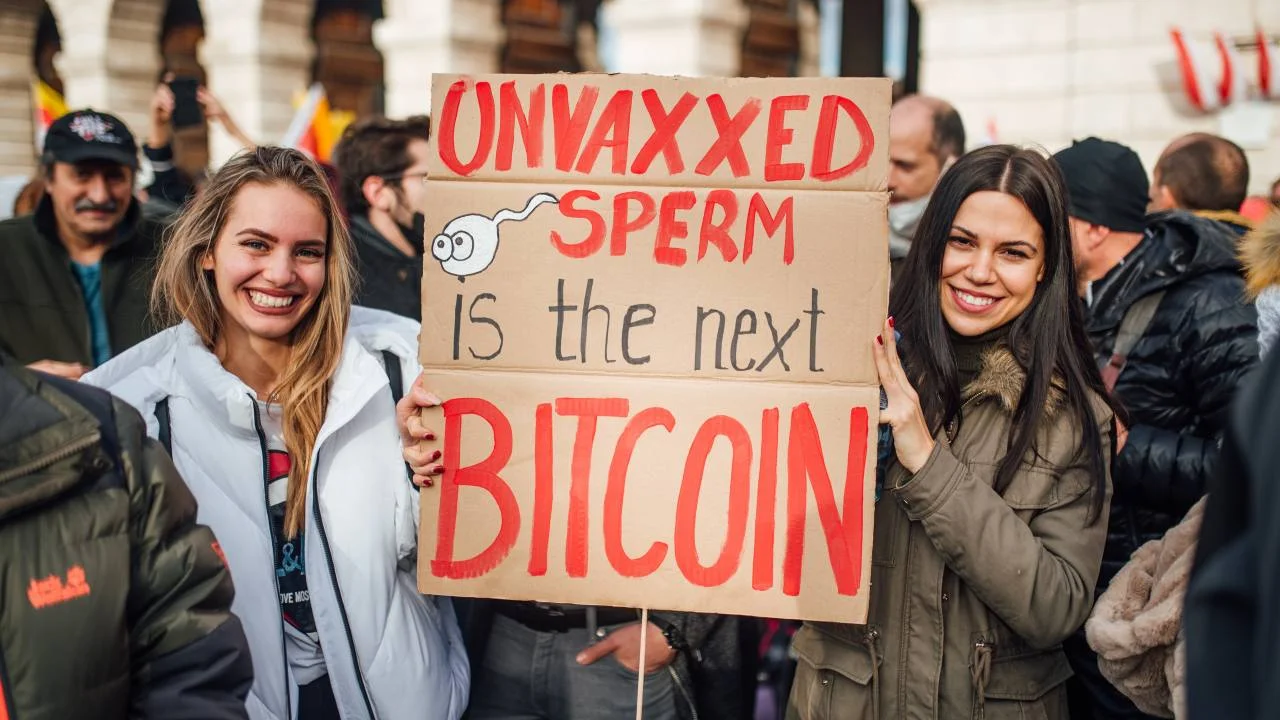
Image source: Wikimedia Commons. A promotional post from the token project at the time described the project itself as inspired by the meme; that documents the marketing, not medical benefit or financial legitimacy.
When medical advice makes sense
A urologic or andrologic evaluation makes sense regardless of vaccination status if:
- pregnancy has not occurred after 12 months of regular unprotected sex;
- fertility risks are already known or fertility treatment is planned;
- semen analyses are repeatedly abnormal;
- there is pain, swelling, a lump, fever, or another symptom in the testicular area;
- a treatment that may threaten fertility is about to begin.
When sperm donation is involved, this article replaces neither medical screening nor advice about the specific donation route.
Conclusion
The fear of sterility from COVID‑19 vaccination is understandable, but research to date does not confirm it. Available studies show no lasting deterioration in common semen parameters, no lower chance of conception, and no consistently worse outcomes in assisted reproduction. A small temporary signal in one sperm-donor study belongs in the full picture, but it is not evidence of permanent infertility.
If you want confidence when trying for a baby or considering sperm donation, do not fixate on a vaccination label. Standardized laboratory values, the time since fever or infection, appropriate screening, traceable documentation, and an honest account of each test's limits tell you more.
Keep reading
Articles that explain testing, the basics, and key terms related to fertility and semen analysis.