Testosterone and fertility: How TRT and anabolic steroids affect your chances of having a child
More testosterone does not automatically mean greater fertility. Testosterone replacement therapy and anabolic steroids can sharply reduce sperm production even when sex drive, erections, and muscle strength remain intact. What matters is hormonal signaling inside the testicles and the actual semen analysis results. This article explains the connection, possible recovery, and the next steps if you want children now or in the future.


At a glance
- Testosterone supplied from outside the body can greatly reduce sperm production or suppress it to the point of azoospermia, meaning no sperm can be detected in a semen sample.
- Medically indicated testosterone replacement therapy and anabolic steroid use for performance enhancement are different situations. Both can, however, reduce the hormonal signals sent to the testicles.
- Sex drive, erections, muscle mass, and visible ejaculation do not reliably show whether you are producing enough sperm.
- Sperm production can recover, but the timing and extent vary. Discuss wanting children now or later early on, and do not change prescribed treatment on your own.
Can testosterone cause infertility?
Yes. Testosterone supplied from outside the body can lower sperm numbers so much that conceiving naturally becomes much harder or impossible. This can happen even if you feel strong, want sex, and have a good-looking testosterone blood test result.
More testosterone in the blood therefore does not automatically mean greater fertility. Sperm production depends on the hormonal conditions inside the testicles. With testosterone products, those conditions can develop very differently from the blood level. This connection is described in the EAU guideline on male infertility and the AUA/ASRM guideline, updated in 2024.
This does not mean every man using testosterone is definitely infertile, or that any impairment must be permanent. Your actual semen results, medical history, and what happens over time are what matter.
Your own testosterone, TRT, and anabolic steroids: Three different situations
Testosterone is first of all a hormone your body makes. Whether it becomes a treatment or a fertility risk depends on the medical context and how it is used.
- Testosterone made by your body
- Your testicles produce most of it. Coordinated hormonal signaling allows testosterone to act throughout the body while maintaining the conditions needed for sperm production inside the testicles. A naturally normal testosterone level is different from a level achieved by taking hormones.
- Testosterone replacement therapy, or TRT
- When testosterone deficiency has been confirmed and the symptoms fit, prescribed replacement therapy can be appropriate. Its purpose is to correct a deficiency, and it requires an established diagnosis and regular follow-up. A medical reason for treatment does not, however, rule out an effect on fertility.
- Anabolic-androgenic steroids for performance enhancement
- Here, testosterone or related substances are used mainly to increase muscle mass and performance. Use outside medical treatment, large amounts, and combinations of several drugs differ substantially from monitored replacement therapy. This often makes health risks and later recovery harder to assess.
TRT and steroid misuse should therefore not be treated as the same thing. In both cases, androgens supplied from outside the body, meaning hormones with testosterone-like effects, can suppress the signals controlling the testicles. Ordinary strength training is a separate matter. A muscular body does not tell you whether someone uses steroids or how fertile they are. The medical context is explained in the EAU guideline on testosterone deficiency.
Why the testicles need testosterone, yet taking it can suppress sperm production
The signaling starts in the brain. The pituitary gland releases two chemical messengers into the blood: LH, or luteinizing hormone, stimulates testosterone production in the testicles. FSH, or follicle-stimulating hormone, supports sperm production together with testosterone inside the testicles.
This requires a much higher testosterone concentration inside the testicles than in the blood. A blood test therefore does not simply tell you whether enough hormone is available where sperm are made. Experimental research into testosterone inside the testicles also illustrates this distinction.
When testosterone is supplied from outside the body, it tells the brain that enough hormone is available. This feedback is called negative feedback. The pituitary then releases less LH and FSH. The testicles make less of their own testosterone, and some of the support from FSH is also lost. Sperm production can consequently fall even while blood testosterone measures normal or high.
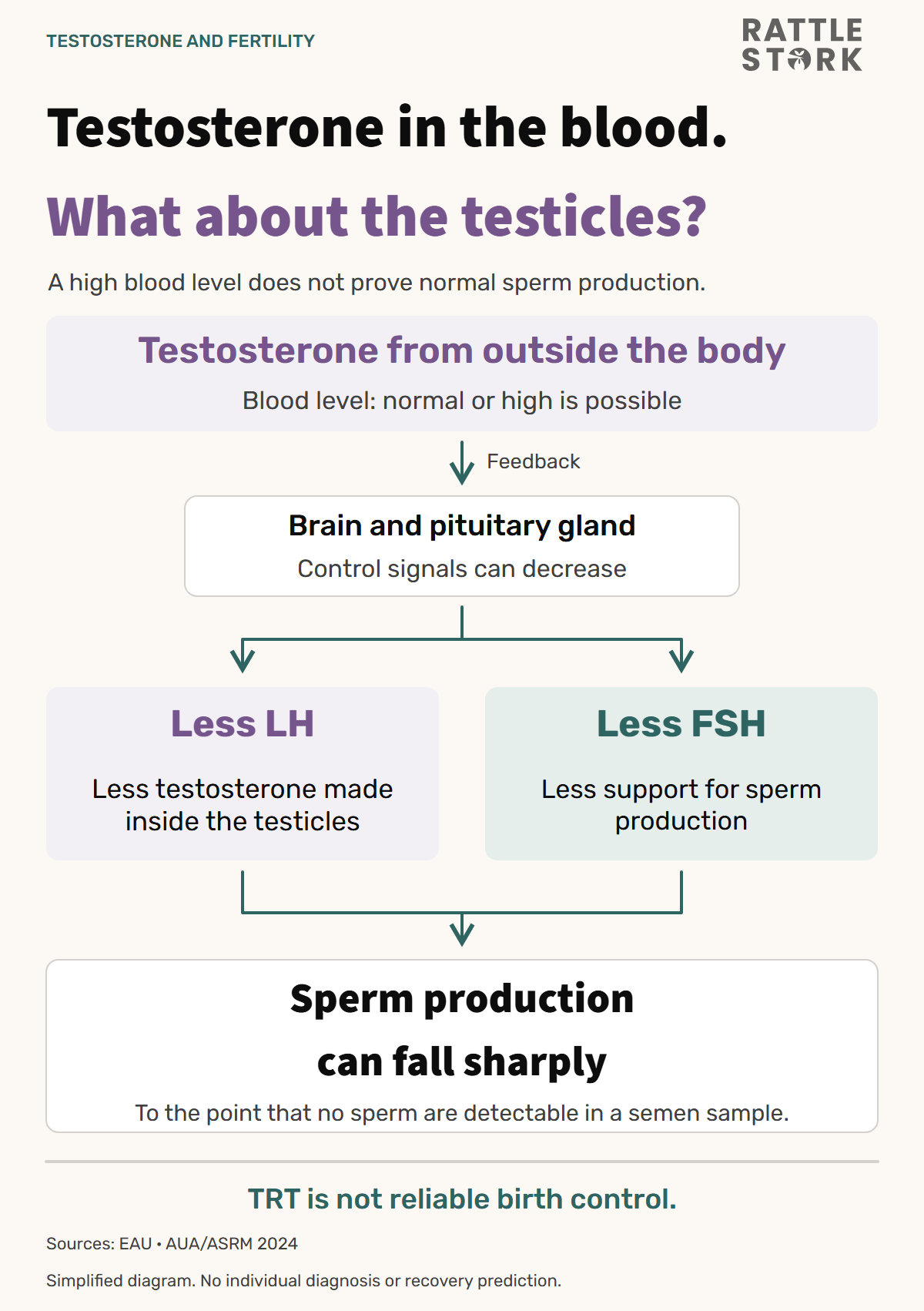
A sperm concentration below the reference range is called oligozoospermia. If no sperm can be detected in a semen sample, the finding is called azoospermia. Neither can be identified by how your body feels.
Gel, injections, or other products: Does the form matter?
A prescribed testosterone gel also supplies testosterone from outside the body. An injection is therefore not the only form relevant to having children. What matters is how a particular treatment affects hormonal signaling and sperm production.
Products differ in how long they act and how much blood levels fluctuate, among other things. That does not translate into a simple way of protecting fertility. Switching products or taking a break on your own is not a reliable solution.
Small studies of short-acting testosterone administered through the nose have reported more favorable semen findings. The AUA/ASRM guideline discusses this research but stresses the limited evidence on how well fertility is preserved in the long term. These early findings therefore do not guarantee that you will remain able to conceive during treatment.
Why sex drive, erections, and ejaculation are not fertility tests
Sexual function and sperm production are related, but they are not the same. Testosterone can affect desire and sexual experience while sperm numbers fall sharply at the same time. A good erection therefore does not rule out abnormal semen results.
The visible semen usually remains present, too. Most of it comes from glands such as the prostate and seminal vesicles; sperm account for only a small part. Even a normal-looking ejaculation can therefore contain no sperm or very few.
The same applies to muscle mass, beard growth, or feeling physically capable. To find out about sperm production, you need a semen analysis. This laboratory test tells you more than looking at the semen or measuring testosterone once. Even a normal result, however, does not guarantee a pregnancy.
What matters when testosterone is low
A low testosterone reading does not automatically mean you need TRT. Tiredness, reduced desire, and declining performance have many possible causes. A deficiency is assessed using compatible symptoms and confirmed laboratory findings, not a single result or an online questionnaire.
During the initial assessment, testosterone is usually measured in the morning while fasting; an unusually low result is confirmed before treatment starts. LH and FSH help distinguish whether the cause lies mainly in the testicles or in the signals controlling them. Illnesses, medications, and other contributing factors also belong in the assessment. This approach is described in the EAU guideline on diagnosing testosterone deficiency.
If you already use testosterone, different considerations apply to test timing and interpretation. Tell the clinician which product you use and when you last used it. If you want children, the assessment should help identify treatment that addresses symptoms while taking family planning into account.
Children now or later: When to bring it up
If you want to conceive now, testosterone use should be considered early in your medical planning. The AUA/ASRM guideline generally advises against prescribing exogenous testosterone, meaning testosterone supplied from outside the body, to men interested in current or future fertility. It is particularly unsuitable as a way to improve fertility when you want to conceive soon.
For men who may want children only in the distant future, the guideline discussion describes an individualized decision after counseling about the effects on sperm production and possible later recovery. This is not a promise that fertility will be maintained or return by a chosen date.
A concrete timeline helps: Do you want to start trying to conceive in the foreseeable future, or keep the option open for later? Both deserve discussion before treatment starts. If you already receive TRT, arrange an appointment to plan together rather than stopping it yourself.
TRT is not a reliable method of birth control. Suppression is not complete in every man. If pregnancy is not wanted, you still need suitable contraception. The Society for Endocrinology guideline explicitly makes this point as well.
Preserving fertility before treatment: Should you freeze sperm?
Before starting planned testosterone treatment, it may be useful to discuss a baseline semen analysis and freezing sperm. This cryopreservation may make fertility treatment possible later if few or no sperm can be detected in semen during testosterone use.
Whether this precaution makes sense for you depends in part on your previous semen findings, diagnosis, and family plans. Freezing sperm is not necessary for every man, and it does not guarantee a future child. It is nevertheless worth addressing before the first use rather than waiting until sperm production is already suppressed. The clinical overview Clinical Management of Male Infertility describes this option in the context of testosterone replacement therapy.
After TRT or anabolic steroids: Can sperm production recover?
Sperm production can recover after the outside hormone supply ends. That does not mean all men follow the same course or that a short break ensures a normal result. The AUA/ASRM guideline describes recovery that can sometimes take a long time; in some men, semen results remain impaired.
Three separate questions matter: Does hormonal signaling restart? Are sperm being produced again? And are the semen findings, together with other fertility factors, sufficient for pregnancy? These stages do not automatically happen at the same time.
In anabolic steroid users, the HAARLEM study showed that blood testosterone and sperm production can recover at different rates. The study followed men using androgens for nonmedical purposes. Its findings cannot be applied to every TRT situation or used as a personal recovery deadline.
Age and duration of use can also play a role. A clinical study by Kohn and colleagues found such associations in men receiving specialist hormone treatment after stopping testosterone. However, this retrospective study of a selected patient group does not predict how quickly an individual man will recover without treatment.
Assessment also takes account of results before use, earlier steroid cycles, the products used, and additional causes of impaired fertility. If no baseline semen analysis was performed, it can be hard to distinguish afterward what was already present. A previous pregnancy does not prove that current sperm production has remained unchanged, either.
What to discuss with your clinician after anabolic steroid use
After nonmedical use, the history is often less clear than with documented TRT. Multiple substances, changing combinations, repeated cycles, and uncertain product contents make assessment harder. Give as much detail as you can, even if you cannot identify every product or amount with certainty.
Mention products taken alongside steroids or as post-cycle therapy, too. This means drugs intended to restart hormonal signaling after a steroid cycle. Self-treatment of this kind proves neither that hormonal signaling has recovered nor that enough sperm are present.
Medical support is also appropriate if you develop symptoms after stopping, such as a marked loss of sex drive or pronounced low mood. The 2026 Society for Endocrinology position statement describes these symptoms and uncertainty about their recovery. You do not need to downplay your use to receive help. The EAU guideline discusses anabolic steroids as a separate contributing factor and emphasizes the limited evidence on treatment afterward. The article on alcohol, nicotine, cannabis, and fertility puts other substances and possible accompanying factors into context.
Which tests are useful when you want children?
Contact a urologist with expertise in andrology. Andrology deals, among other things, with male hormones and fertility. When testosterone or anabolic steroids are a known influence, early assessment makes sense; you do not need to wait through a long period of unsuccessful attempts.
History and physical examination
Important details include the products used, duration of use, last use, previous cycles, and other drugs or supplements. Existing packaging or photographs can help. Previous testicular problems, operations, illnesses, and pregnancies also belong in the discussion. A physical examination complements the laboratory findings.
Semen analysis shows the current semen findings
The laboratory test assesses sperm number and movement, among other things. Abnormal findings are often checked with another sample because semen results can vary. The guide to semen analysis explains how to prepare.
If no sperm are detected, the finding needs careful confirmation and assessment. Azoospermia during testosterone use may be explained by hormonal suppression, but that must not lead to other causes being overlooked. The finding alone does not establish permanent infertility.
Hormone tests help narrow down the cause
Depending on the situation, testosterone, LH, FSH, and possibly other tests may be useful. Suppressed signaling during ongoing use is interpreted differently from signaling without an outside hormone supply. Discuss when the blood sample should be taken in relation to using the product as well.
These steps follow the basic approach in the EAU guideline on assessing male infertility. Further tests depend on the specific findings. Not everyone automatically needs every genetic test or imaging examination. The article on male infertility provides an overview of other causes.
Treatment: Plan symptom care and fertility together
Do not change prescribed testosterone treatment on your own. The next step depends on why testosterone was prescribed, your semen findings, and how soon you want children. Sometimes the first priority is a coordinated treatment change and follow-up checks.
For certain hormonal disorders, medications prescribed by a clinician can stimulate the body's own testicular function. These include selected uses of gonadotropins, signaling hormones such as hCG or FSH. Other drugs act on hormonal feedback. Whether this is appropriate depends on the cause; a primary problem in the testicles does not respond to this approach in the same way as missing control signals.
The AUA/ASRM guideline describes these options for selected patients and notes limited evidence. This does not establish a routine add-on program for every TRT prescription or provide instructions for self-treatment. Even additional hormones do not guarantee that sperm production will be maintained during testosterone use.
If results remain impaired, assisted reproduction options can be discussed. Whether available sperm can be used and which procedure fits depend on the overall situation. One possible option is ICSI, in which a single sperm is placed directly into an egg. Both partners' care should be coordinated in time, rather than basing the entire plan on one testosterone reading. Discuss together how long it is medically reasonable to wait and which options to consider early.
Conclusion
More testosterone in the blood does not automatically mean greater fertility. Testosterone supplied from outside the body can suppress sperm production even with a good sex drive and normal ejaculation. If you want children now or later, early andrology advice, a semen analysis, and treatment that considers symptoms and family planning together can help.
Understanding sperm production and test results
These articles explain semen analysis, other causes of male infertility, and the finding of azoospermia.