Longer or Thicker Penis: What Actually Matters?
When surveys force women to choose between length and thickness, small studies mention girth somewhat more often. That does not mean thicker is always better. Length and girth change different sensations, and either can feel good or become too much. What matters is how two bodies fit together, not which number wins.

The direct answer
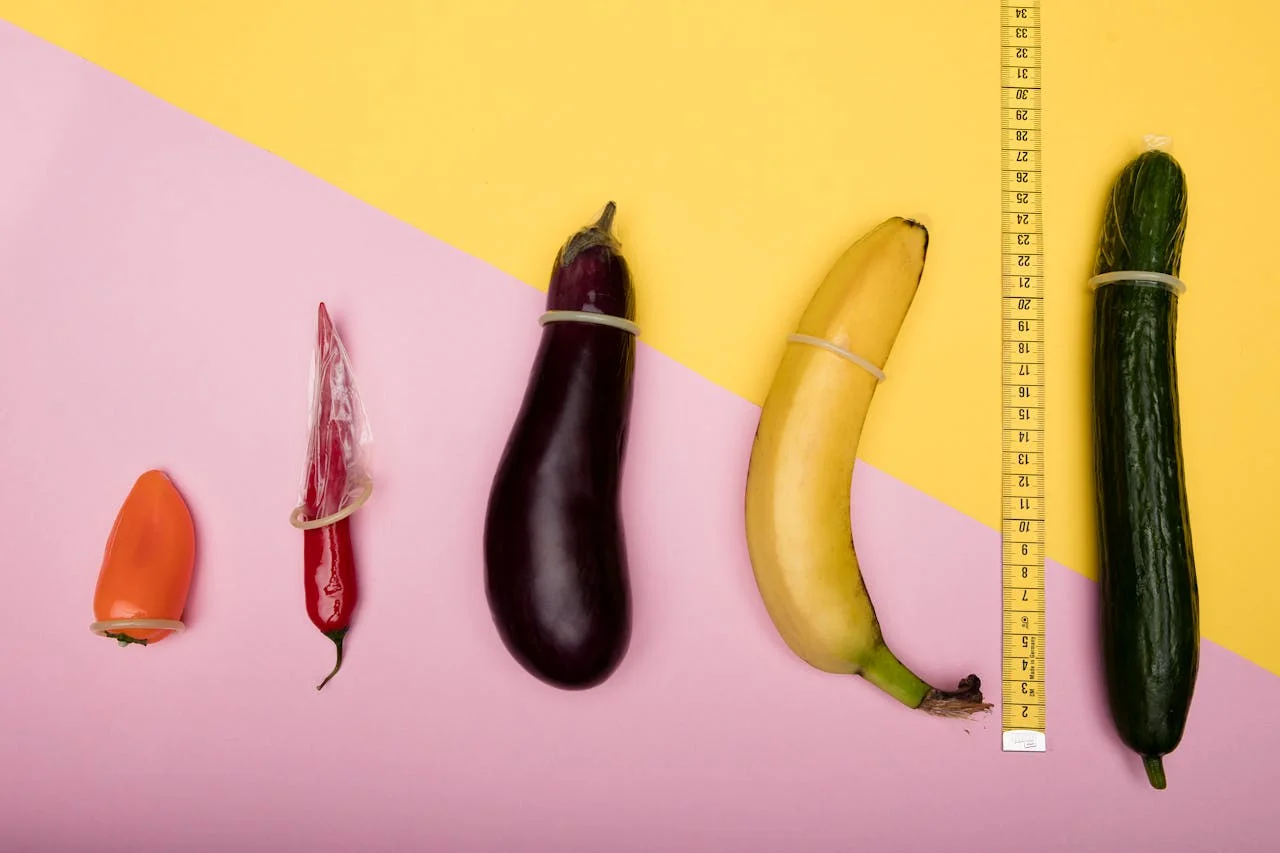
When the only choices are longer or thicker, some surveys mention girth more often. The evidence is based on small samples, however. Even if the tendency is real, it does not answer the most important practical question: Which combination feels comfortable for two particular people?
More girth often creates a sense of pressure or fullness sooner. More length primarily changes the depth that can be reached. Either can be welcome, go unnoticed, or cause pain. There is no objective winner.
What longer and thicker actually describe
Length is measured from the pubic bone to the tip of the glans. In everyday conversation, thickness usually means the circumference of the erect shaft, not its diameter. Those terms are often mixed up. A penis can be long and narrow, shorter and wider, or close to average in both measurements.
A large measurement review found averages of about 13.1 cm in erect length and 11.7 cm in erect girth. The normal distribution is broad. These figures provide context, but they cannot predict which combination will feel good to a particular person. Veale et al. 2015
Shape also matters during sex. The glans, the distribution of girth, natural curvature, and erection firmness all affect contact. The popular choice between longer and thicker reduces several features to two catchphrases.
What the studies actually support
An often-cited survey of 50 college students found that 45 considered girth more important than length. That is a clear result in a very small, nonrepresentative sample. The survey also asked for an opinion rather than measuring sexual experience. Eisenman 2001
In another survey, 170 women responded after childbirth. Most considered length unimportant, while girth was rated as relevant somewhat more often. This group does not represent all women either. Francken et al. 2002
The familiar study using 3D models examined length and girth together. Participants' average selections were above common measurement references, while the difference between a one-time encounter and a long-term relationship was small. It does not prove that more is always better or establish a universal preferred size. Prause et al. 2015
For a closer look at the evidence and its limits, see Do women prefer larger penises?
How length and girth create different sensations
The vagina is not a rigid tube. Arousal changes blood flow, lubrication, length, and muscle tension. The same girth may therefore feel comfortable one day and too intense another. Stress, pain, or too little time for arousal can increase muscular tension.
Length becomes most noticeable during deep penetration. Angle and position help determine whether that reaches a pleasurable area or creates uncomfortable pressure. A longer penis does not need to be inserted fully. Depth can be controlled and is not a performance goal.
Greater girth may be noticeable during entry sooner than a small difference in length. Noticeable does not automatically mean pleasurable. A sensation may feel good, neutral, or too intense. The same applies to depth that is barely noticeable in one position and immediate in another.
Preference studies do not provide a universal perception threshold. Claims that women notice every extra centimeter or that sex improves above a particular girth are not supported scientifically. Anatomy, arousal, muscle tension, and attention have too much influence.
Pain at the opening and deep pain are not the same
If penetration burns, feels tight, or hurts at the opening, friction, dryness, infections, skin conditions, or involuntary pelvic-floor tension may be important. Greater girth can intensify the problem but is not automatically its cause.
Deep pain occurs farther inside and may relate more strongly to depth and angle. Endometriosis, inflammation, and other gynecologic causes may also contribute. Simply deciding that the penis is too large would overlook those distinctions.
Recurring pain deserves medical attention even if it appears only in certain positions or with particular partners. The British health service lists infections, skin problems, endometriosis, pelvic-floor problems, and hormonal changes among possible contributors. NHS sexual therapy: Difficulties with vaginal penetration
Specialized pelvic-floor physical therapy can help when muscles are overactive or poorly coordinated. Care may include education, relaxation, manual techniques, and an individualized exercise program. Studies report improvements in pain and quality of life, although methods and study populations differ considerably. Systematic review of physical therapy for dyspareunia
When length or girth becomes too much
Greater girth can make entry difficult or increase friction and pressure. That is not a defect in the penis or the receiving partner's fault. It describes the fit in that particular situation. More time, gradual entry, adequate arousal, and lubricant when needed often change more than any measurement.
Pain should not be dismissed as a necessary adjustment period. If penetration regularly hurts, remains impossible despite changes, or causes bleeding, a gynecologic or sexual-medicine evaluation is appropriate. Possible causes range from dryness and infections to pelvic-floor tension and other pain conditions.
With greater length, the issue is more often excessive depth than entry. Positions that limit depth and give the receiving partner control can help. A slow pace and clear feedback matter more than supposedly impressive deep thrusts.
In either case, two bodies are meeting. Anatomy, cycle phase, arousal, position, and prior experience all change the sensation. Saying that a penis is too large therefore describes a particular fit or pain problem, not a fixed verdict about a body.
What can help couples in practice
The most useful changes are rarely complicated: Allow more time for arousal, begin slowly, and exchange feedback regularly. Lubricant can reduce friction but cannot replace arousal or medical evaluation for persistent pain.
With greater length, positions in which the receiving partner controls depth and pace, or where range of motion is limited from the start, can help. Side-by-side positions and a shallower angle are often easier to control. With greater girth, gradual entry without time pressure matters most.
Devices designed to limit penetration depth can help some couples. They must be safe, intended for that purpose, and comfortable. Improvised hard objects or painful experiments are not a solution.
A list of positions is still not a prescription. What helps depends on whether pain occurs at the opening, deep in the pelvis, or only at one angle. Rather than trying ten positions, identify the problem each adjustment is meant to solve.
No one is to blame for a difficult fit
When a particular combination of length, girth, and anatomy makes sex difficult, it is not simply the woman's fault or automatically the man's. Two bodies, an arousal state, and a particular movement meet. Blame makes adaptation harder and increases tension.
Useful language is concrete: That angle hurts. This pace feels good. We need more time here. Penetration is not working well today. A judgment of someone's body becomes actionable information about the situation.
How natural curvature affects fit
Many penises have a slight curve. A painless shape that has remained unchanged since puberty may be a normal or congenital variation. Its direction changes where pressure occurs during penetration. Some couples enjoy that sensation; others adjust the angle or position.
A new, increasing, or painful curve is different. It may indicate Peyronie's disease, especially when a hard plaque, indentation, shortening, or erection problem also appears. That is no longer only a question of sexual fit but a possible urologic condition. EAU guideline on penile curvature
How to measure your penis accurately includes how to document a curve and when to have it examined.
Can a penis be too small?
Within the normal distribution, smaller is not automatically worse. Many forms of stimulation depend very little on maximum penetration depth. Positions, movement, hands, mouths, and sex toys provide far more variation than shaft length alone.
Medically, a micropenis is different from a penis below the average. Diagnosis is based on standardized stretched length and the complete clinical picture. In daily life, the important questions are whether sex, erections, and ejaculation function and whether both people feel comfortable. Penis size worldwide explains reference values and the limits of comparison.
Fantasy, porn, and the desire for more
Length and girth are visible features and easy to market. Pornography uses unusual bodies and camera angles; advertising then sells devices, pills, or surgery as solutions to a problem often created by that comparison.
A fantasy about extreme size is not wrong. It is simply not medical advice or a reliable description of what remains comfortable in daily life. When large dimensions cause pain, the limit of the more-is-better idea becomes very concrete.

Can length or girth be increased permanently?
There is no simple, safe way to produce substantial permanent growth in a normally developed adult penis. Vacuum pumps can temporarily improve fullness, pills and creams have no reliable enlargement effect, and aggressive stretching can cause injury. In selected situations, medical traction used for months may produce modest rather than dramatic changes.
Surgery or injections can alter measurements or appearance, but they carry risks such as scarring, unevenness, changes in sensation, infection, and dissatisfaction. The decision should never come from an online ranking. A fuller discussion of benefits and harms appears in the main article about penis size and enlargement.
Girth matters most for condoms
Condom fit turns the discussion into a practical question. A condom that is too tight can feel uncomfortable and may be damaged more easily; one that is too loose can slip. Erect girth is therefore a better starting point than guessing whether a penis is long or thick.
Measure with a flexible tape without squeezing and use nominal width on the package as a guide. How to choose the right condom size explains the calculation. Instructions for length and girth are in How to measure your penis accurately.
A preference remains a preference
A measurement can satisfy curiosity, but it says nothing about attentiveness. Good coordination keeps pace, depth, and pressure adjustable. It also means not treating a stop signal as a personal insult and taking positive feedback seriously.
Some people have a clear preference, and that is valid. It becomes harmful when one preference is declared a universal body standard or pain is hidden out of shame. Then comparison causes more harm than clarity.
When medical help makes sense
Recurring pain, bleeding, involuntary muscle tightening, sudden severe dryness, or penetration that is barely possible should be evaluated in gynecologic or sexual-medicine care. A new curve, palpable plaque, erection problems, or penile pain belongs in urology.
An injury with a popping sound, rapid swelling, and bruising is urgent. A painful erection lasting several hours is also an emergency. Different positions or waiting longer will not solve those situations.
Myths and facts about length, girth, and curvature
- Myth: Thicker is always better than longer.
- Fact: Small surveys mention girth more often, but poor fit can make it painful too.
- Myth: Deeper automatically means more pleasure.
- Fact: Depth can feel pleasurable, neutral, or painful and depends strongly on angle and anatomy.
- Myth: If sex hurts, the woman simply needs to get used to it.
- Fact: Pain is information. Arousal, pace, fit, and possible medical conditions must be taken seriously.
- Myth: A smaller penis cannot provide good stimulation.
- Fact: Sexuality includes far more than maximum penetration depth; attention and appropriate stimulation do not require a minimum length.
- Myth: Every curve is Peyronie's disease.
- Fact: Mild stable curves may be congenital or normal. A new, painful, or worsening curve should be evaluated.
- Myth: The perfect position makes every size difference disappear.
- Fact: Positions can control depth and pressure, but they do not treat an infection, pain disorder, or marked pelvic-floor tension.
Conclusion
Small studies mention girth as important somewhat more often, but thicker is not automatically better and neither is longer. Length mainly affects depth, while girth affects pressure and stretching. Whether either feels good depends on both bodies and the situation. The best answer is not a number but a combination of fit, arousal, control, and open communication.
Put length and girth in context
Explore preference studies, accurate measurement, and practical help with condom fit.