Which position helps you get pregnant? Sex positions, timing and myths
Missionary, cowgirl or doggy style: couples trying to conceive hear many recommendations, but no particular sex position has a proven advantage. How plausible are the theories about gravity and penetration depth? This article explains the main positions, what studies actually show, and what matters when timing sex and afterwards.


At a glance
- No sex position is proven to be better than the others for getting pregnant. Choose a comfortable position that does not cause pain.
- Gravity and penetration depth can affect where semen lies. This has not been shown to result in more pregnancies.
- The days before ovulation and regular sex are more important for conception than a particular angle.
- Semen flowing back out and urinating after sex do not rule out pregnancy.
Is there a best position to get pregnant?
Current medical knowledge does not identify a best position to recommend. The American Society for Reproductive Medicine, ASRM, finds no proven conception advantage from a specific sex position or resting for longer afterwards. ASRM: natural fertility
Choosing a position can still make a difference for you as a couple. When vaginal sex with ejaculation inside the vagina is comfortable and manageable, it is often easier to have sex regularly. This practical benefit is different from saying that a particular angle directly increases the chance of fertilisation.
What happens to sperm after sex
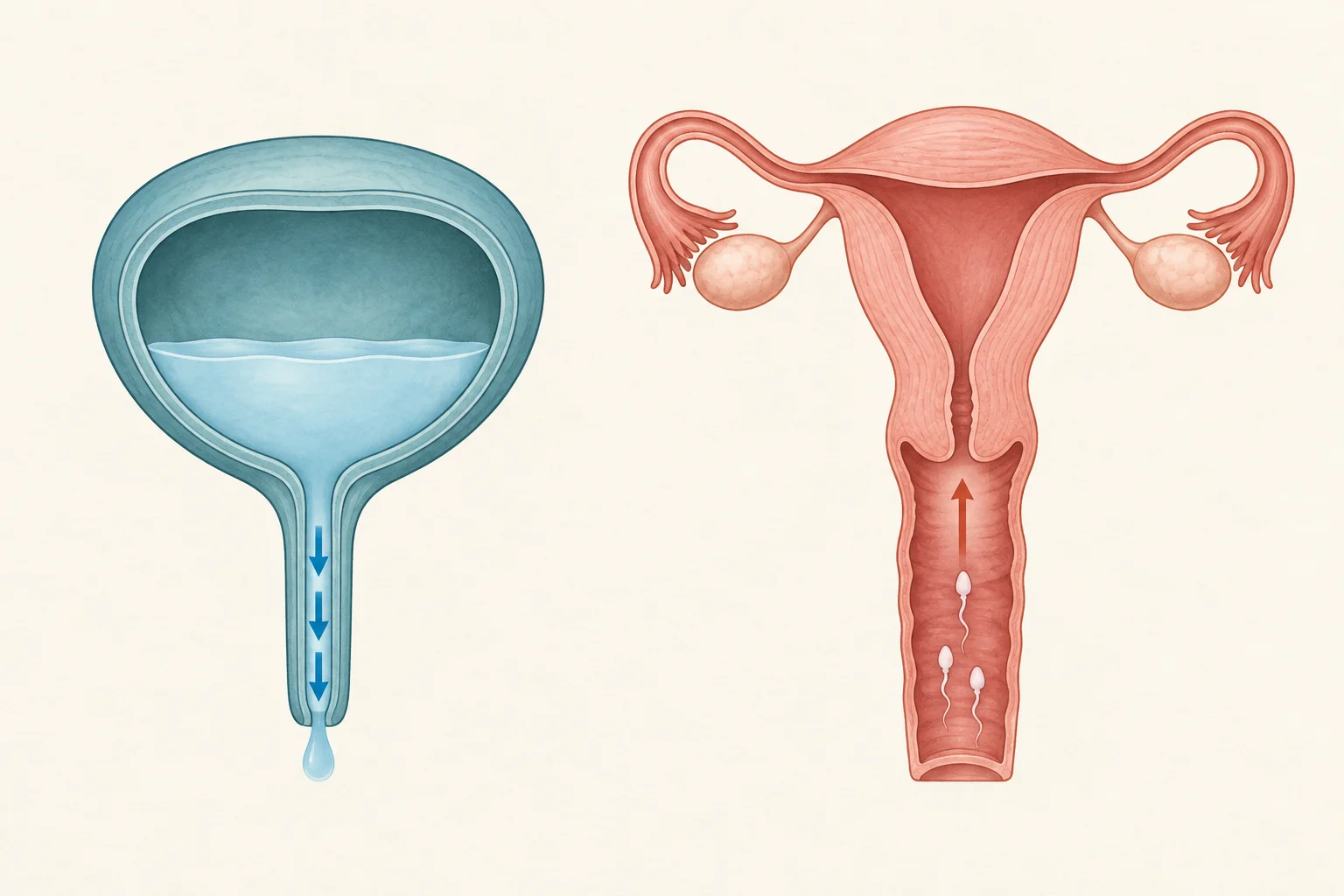
With ejaculation inside the vagina, semen is first deposited there. Sperm that can move may then pass through the cervix into the uterus and onwards towards the fallopian tubes. Fertilisation can occur there if an egg capable of being fertilised is present. Only a small proportion of sperm reach that far. familienplanung.de: ovulation and fertilisation
The initial location of the semen is not all that matters. Moving sperm, open fallopian tubes and appropriate timing around ovulation are among the important factors. A position does not resolve problems along this route. To understand semen, sperm and sperm quality as separate concepts, read our overview of semen.
Gravity and penetration depth: how much is there to these theories?
Lying down is supposed to retain more semen, and deeper penetration is supposed to shorten its journey. These are two common ideas. Both are plausible as physical mechanisms, but the key question is whether they actually lead to pregnancy more often.
Gravity affects fluid, but does not explain the entire journey
Gravity affects the direction in which fluid flows, so you may see more flow out when you stand up. Sperm do not travel along a purely passive path upwards or downwards. They enter cervical mucus, the mucus in the cervix. Their own movement and uterine contractions help transport them further.
A 1996 study tracked labelled particles the size of sperm from the external opening of the cervix and studied wave-like uterine contractions. The findings support the significance of the body's transport mechanisms. However, the researchers examined particles and routes, not pregnancy rates for different sex positions. Kunz et al.: transport in the reproductive tract
What this means: Less visible fluid flowing back out does not automatically mean a higher chance of pregnancy. Pregnancy is possible in cowgirl and standing positions too. You do not have to remain lying down to conceive.
Deeper penetration does not automatically produce more pregnancies
Greater penetration depth can change where semen is released in the vagina. These structures can also shift: a small MRI study in 1999 showed changes in the vagina and the position of the uterus during arousal and penetration. It visualised physical processes but did not investigate a conception benefit from deeper penetration. Schultz et al.: MRI during sex and arousal
A shorter route to the cervix may sound helpful. But it has not been shown to lead to more pregnancies when ejaculation occurs within the vagina. There is no required penetration depth in centimetres. The penis does not need to touch or press against the cervix; a smaller penis does not exclude pregnancy either.
How large might any benefit be?
The available data cannot give a reliable ranking or percentage. A lack of evidence for a benefit does not prove that every possible effect is absent. To recommend a position, though, studies would have to show that it actually leads to more pregnancies or births. Anatomical images and a reduction in leaking fluid cannot establish that.
What to do in practice: You can lie comfortably on your back or use a pillow. You do not need to endure pain. Choose a comfortable position and focus on the fertile days.
Sex positions by name: the main options explained
Many names describe the same basic position or slight variations. When discussing conception, this guide focuses on vaginal intercourse; a position from behind, for instance, does not automatically mean anal sex. For the general process and differences between sexual practices, see How does sex work?
- Missionary position
- One person lies on their back and the other is above them, facing towards them. Eye contact and communication are easy. The angle changes with leg placement and support; body weight should remain comfortably distributed.
- Doggy style
- This is a position from behind, often kneeling, with the person in front supporting their weight on their hands or forearms. The angle may permit deeper penetration. Let each other know early if anything presses or hurts.
- Cowgirl or riding position
- The person with a vagina sits on top, usually facing the person lying underneath. This often allows them to limit the depth themselves. The knees and thighs bear more weight, however. Comfort therefore also depends on flexibility, the surface and support.
- Reverse cowgirl
- The person on top faces the opposite direction from the usual cowgirl position. This changes the angle and body contact, making direct eye contact more difficult. Slow, coordinated movement is sensible when changing positions. The knees and thighs may be under more strain, as in cowgirl.
- Spooning
- Both people lie on their sides, one behind the other. The surface supports much of their body weight and movements are often smaller. It may be comfortable when you are tired or want to reduce physical effort. Adjusting the placement of the legs can change the position.
- Seated and lotus positions
- In a seated position, both people face each other with one on the other's lap. Lotus is a closer variation, often with crossed legs. It allows considerable body contact, but may need flexibility in the hips and knees, depending on the version. A comfortable seated position does not require a particular name.
- Edge-of-bed and butterfly positions
- In an edge-of-bed position, one person lies near the edge of a stable surface while the other stands or kneels in front. Butterfly often refers to a variation with one person lying on their back, legs raised or open. Height, support and angle affect comfort; the name is not defined in the same way everywhere.
- Standing position
- Both people remain mostly standing. Height, balance and a secure hold matter more than in lying positions. Stable support can help; move to another position if it gets tiring.
- Viennese oyster
- This usually refers to a missionary variation with the legs lifted high towards the upper body. It can allow deeper penetration and needs more flexibility. You do not have to try or tolerate it to get pregnant.
- Scissors position
- The term covers different positions with the legs offset to the side or interlocked. Some involve vaginal penetration, whereas others mainly involve external contact. The name alone does not explain the exact activity or whether pregnancy is possible.
- Coital alignment technique
- This is a modified missionary position in which body alignment and contact focus more on external stimulation of the clitoris. It is about making sex enjoyable, and has no proven advantage as a conception technique.
- 69
- 69 means mutual oral sex. It is one form of sexual intimacy but not a position for vaginal intercourse. Oral sex on its own does not cause pregnancy; sperm would also have to reach the vaginal opening or enter the vagina.
Names such as monkey style, pretzel and spork do not have uniform definitions. Explain to each other the body position you mean instead. Understanding one another is more useful than knowing a large number of position names.
Which position suits you both?
There is no need to follow a checklist of positions or change constantly. One or two familiar options that can be adjusted to your needs are often enough.
- For less strain: A side-lying position can help because the arms and knees do not need to carry much weight for long.
- For control of depth: A position where the person with a vagina can help control movement and distance, such as cowgirl, may feel more comfortable.
- For eye contact and closeness: A seated position or one with a person lying on their back can work well if you are facing each other.
- For differences in height: A stable surface, a different sitting height or a supportive pillow can make trying positions easier.
A rear-entry position is often suggested for a uterus that tilts backwards. This is commonly a normal anatomical variation and is usually not an obstacle to fertility on its own. When pain or endometriosis is also present, its underlying cause matters. A particular position is not a treatment for it. Cleveland Clinic: retroverted uterus
You do not need a medical reason for disliking a position. More on arousal, communication and a calm start is available in the guides to foreplay and the first time. If you need comfortable positions during an existing pregnancy, see the separate guide to sex during pregnancy.
Orgasm, pillows and the baby's sex: more theories
There are common promises about orgasm and behaviour after sex as well. These three do not hold up when the suggested benefits are examined:
- Raising the legs and using a pillow under the buttocks improves the chances
- No additional benefit has been shown for such routines. A pillow may certainly make you comfortable; there is no prescribed pelvic height or waiting time for natural conception.
- A female orgasm is needed for sperm to reach their destination
- An orgasm can trigger muscle contractions and has been studied as a possible influence on transport. A pregnancy benefit has not been demonstrated. An orgasm is not essential for conception, and you do not have to time it with ejaculation.
- The position decides whether the baby will be a boy or a girl
- There is no convincing evidence that position, penetration depth or a particular sequence of sexual activity can control the baby's sex.
The ASRM review discusses these questions about positions, behaviour after sex, orgasm and sex selection together. ASRM: recommendations for natural conception
Timing: when sex offers the best chance
The fertile window includes approximately the five days before ovulation and ovulation day itself. Sperm may survive for several days in favourable conditions; an egg can be fertilised for only a short time after ovulation. This makes the days before it particularly important. Waiting only for the supposedly exact moment of ovulation may cause you to miss useful opportunities. familienplanung.de: fertile days
A calendar gives an estimate rather than confirming ovulation. Timing can change even with regular cycles. Cervical mucus changes and LH tests provide further clues, but trying to conceive does not have to become a minute-by-minute task. See the explanations of ovulation and LH tests.
For example, if ovulation is expected over the weekend, sex in the preceding days may already fall within the fertile window. You do not have to wait until Sunday or for a positive LH test.
How often to have sex when trying to conceive
Sex every two to three days throughout the cycle is a practical approach. It avoids the need to predict ovulation exactly. This is also the guidance given by the NHS. NHS: trying to get pregnant
When focusing on the fertile window, having sex every one to two days is a common recommendation. Daily sex is also possible when test results are normal; saving up sperm for a longer time is generally unnecessary. ASRM: frequency of sex for conception
The frequency should suit both of you. Instructions before giving a semen sample or undergoing treatment concern a different situation and should be discussed with the clinic.
If every fertile day feels compulsory, the plan can be simplified. Missing one opportunity does not mean the entire cycle has been handled wrongly. Not getting pregnant immediately, even with good timing, is not evidence that the position was unsuitable.
Lubricants: keeping comfort and conception in mind
More time for arousal and a suitable lubricant may help when there is dryness. Some products impair sperm under laboratory conditions. However, observational studies of couples did not show a corresponding overall fall in conception likelihood with lubricant use. Laboratory findings therefore cannot be applied directly to a single instance of use during sex.
If you need a lubricant, a product labelled for trying to conceive and tested for sperm compatibility is a reasonable choice. This does not mean it increases fertility. Do not use saliva or whatever household oil is available as a supposed fertility trick. The different findings are explained in the ASRM review.
When certain positions hurt
You do not need to endure a painful position when trying to conceive. Less depth, another position, more time or a pause may help immediately. Describe clearly whether it burns at the entrance, presses deep inside or pulls during a particular movement. This helps with adjustments and with any later examination.
Recurring or severe pain should be assessed by a gynaecologist. Possible causes include dryness, pelvic floor problems, infections and endometriosis. A change of position can alter symptoms but is not a substitute for assessment. ACOG: pain during sex
If pain, erection difficulties or ejaculation problems make vaginal sex barely possible, you do not have to spend months experimenting with positions before seeking help. Medical advice can be useful earlier. Intercourse is not a requirement for sperm donation; for the separate topic of vaginal insemination, see the guide to the cup method.
After sex: lying down and semen flowing out
It is normal for fluid to flow back out of the vagina after sex. It can include semen, vaginal secretions and sperm. The visible amount does not show how many sperm have already travelled towards the cervix. A lot of fluid on the bedsheet therefore does not mean the attempt has failed.
You can stay lying down if you are comfortable or get up if you have something else to do. When trying to conceive naturally, there is no proven minimum time you need to lie down after sex. Raising the legs against a wall, using a pillow under the buttocks or deliberately retaining fluid is not necessary.
Studies of resting after intrauterine insemination have reached different conclusions: a 2009 study found a benefit from lying down for 15 minutes, but a larger study in 2017 did not confirm it. The treatment involves placing prepared sperm directly into the uterus. These findings cannot establish a requirement to lie down after sex. During treatment, follow your clinic's instructions. Custers et al., 2009, van Rijswijk et al., 2017
The later process of implantation is separate and occurs in the days after fertilisation. Standing up immediately after sex cannot reverse it.
Can I use the toilet after sex?
Yes. Urinating after sex does not wash sperm out of the vagina or prevent pregnancy. Urine leaves the bladder through the urethra; the vaginal opening is separate. Passing urine therefore does not empty the route sperm use to reach the uterus. MedlinePlus: vaginal anatomy
If you feel the need to urinate, use the toilet. Avoiding unnecessary delays when you need to go is sensible for bladder health, although urinating after sex does not guarantee protection against urinary tract infections. You do not have to put up with a full bladder when trying to conceive. NIDDK: bladder health
Burning and a frequent urge to urinate immediately after sex are not reliable signs of pregnancy. If these symptoms are the main concern, read the explanation of bladder symptoms after sex.
Showering, washing and vaginal douching
The outer genital area can be gently cleaned with water. The inside of the vagina does not need to be rinsed: douching can disturb the natural vaginal flora and does not prevent pregnancy. No special cleaning ritual is needed when trying to conceive either. Office on Women's Health: douching
If you do not want to get pregnant right now
The same understanding applies in reverse. Sex while standing, cowgirl, getting up, showering or passing urine do not protect against pregnancy. Risk may exist even without visible ejaculation; see the article on pre-ejaculate for more information.
Emergency contraception may be relevant after unprotected sex or contraceptive failure. Seek advice from a pharmacist or doctor as soon as possible. Depending on the active ingredient, an emergency contraceptive pill may be an option for up to three or five days after sex; taking it as early as possible is important. A copper IUD may also be an option for emergency contraception. Do not wait for symptoms or a pregnancy test. gesund.bund.de: emergency contraception
Reliable contraception is needed for future protection. The guide to correct condom use helps with common mistakes.
When a pregnancy test is useful
A test immediately after sex cannot yet tell you whether pregnancy will result. Most urine tests are useful from the day your period is missed. If you do not know when it is due, testing at least 21 days after the last unprotected sex is a helpful guide. Follow the instructions supplied with the test as well. NHS: pregnancy tests
If an early test is negative and your period still does not arrive, repeating it after a few days may be useful. The position, the amount of fluid that flowed out or a feeling immediately after sex cannot settle this question. See Am I pregnant? for more.
When to seek a fertility assessment
If pregnancy does not occur, at some point an assessment of both partners is more helpful than another position tip. ASRM gives the following guidance for regular unprotected sex:
- Below 35 years: Assessment after 12 months without pregnancy.
- Between 35 and 40 years: Assessment after six months.
- Above 40 years: Prompt advice can be helpful from the beginning.
These ages refer to the person trying to get pregnant through sex. Earlier assessment is useful if periods are absent or very irregular, or if pain or a known fertility-related condition is present. The same applies to suspected problems with sperm, erections or ejaculation. Both partners should be involved from the outset. ASRM: fertility evaluation
A semen analysis can be just as relevant as checking ovulation or the fallopian tubes. An assessment is not a judgement of your sex life. It is meant to identify any treatable factor that may have been overlooked.
A simple plan without pressure over positions
- Choose one or two positions that feel comfortable and allow you to communicate easily.
- Plan for regular sex without concentrating every encounter on one calculated ovulation day.
- Take dryness and pain seriously, and adjust what you do instead of enduring a position.
- After sex, follow what feels comfortable: remain lying down, get up or use the toilet.
- Seek support in good time if pregnancy is not happening or sex becomes a continuing source of strain.
Closeness can also happen without penetration or ejaculation. Not every encounter needs to be an attempt at conception. For broader guidance on preparing for pregnancy, see Getting pregnant: what can help.
Conclusion
The ideas about gravity and penetration depth have a plausible physical basis. So far, though, they have not been shown to improve the chance of pregnancy. Choose a position you enjoy, have sex regularly during the fertile window and seek timely medical advice if needed. Penetration depth, and whether you stand up or use the toilet afterwards, do not need to become a performance test.
Read more
These articles help you recognise fertile days, understand implantation and find the right time to take a pregnancy test.