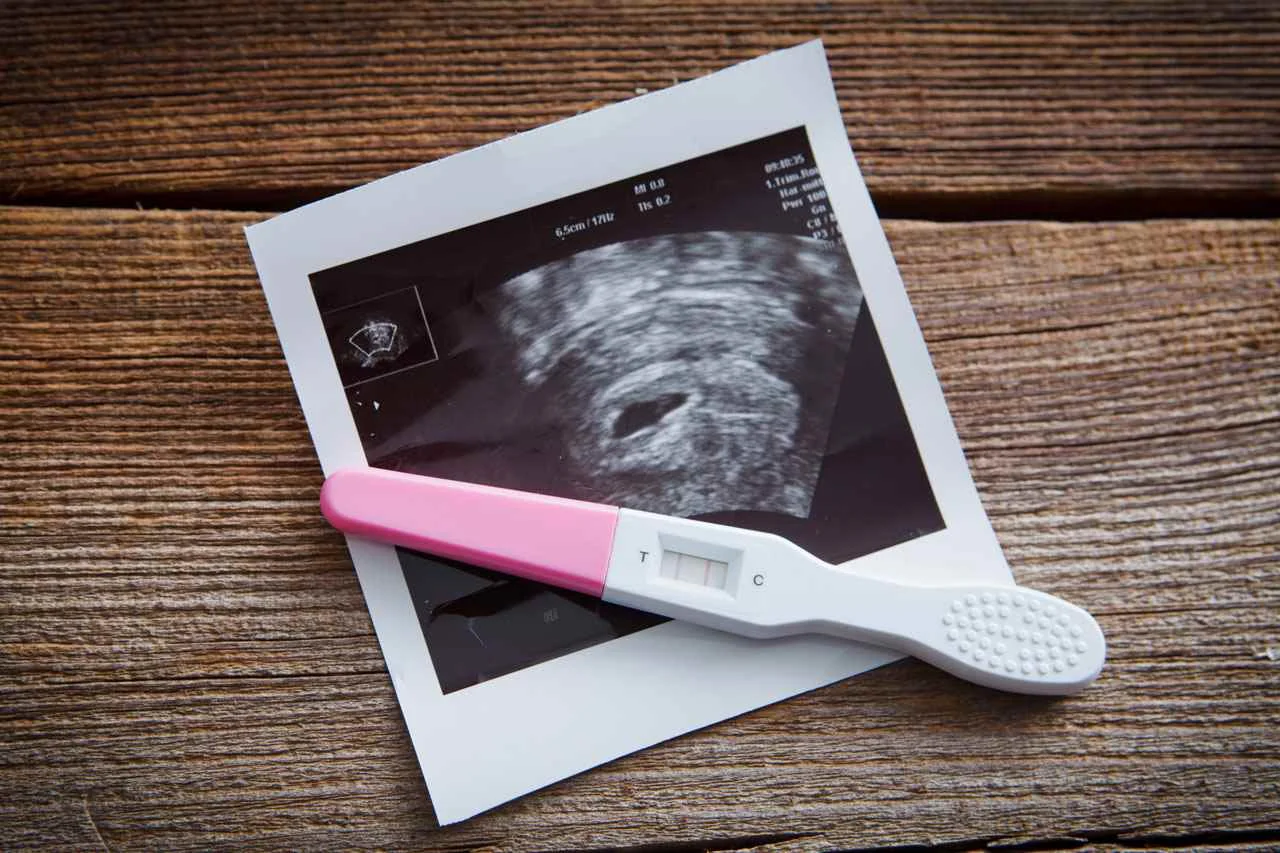
Biochemical pregnancy: early positive test, early bleeding, and what matters now
An early positive test followed by bleeding or a negative retest can create hope, confusion, and anxiety within the same few days. This article explains in clear medical language what a biochemical pregnancy is, how these very early patterns are usually understood, what they do not automatically mean, and when symptoms or changing test results should be reviewed by a doctor.


What a biochemical pregnancy means medically
A biochemical pregnancy is a very early pregnancy detected by measurable hCG in urine or blood before a pregnancy can be reliably seen on ultrasound. That is how the term is used in reproductive medicine. ASRM: International Glossary on Infertility and Fertility Care
The key point is that this is not an imaginary event and not automatically a faulty test. If hCG was truly detectable, a pregnancy had begun. The term mainly describes that it ended very early, before ultrasound confirmation would be expected.
Why people notice it more often now
More people test earlier than they used to, sometimes even before a missed period. Modern home tests can pick up very early hCG rises, so patterns that once looked like a slightly delayed or heavier period are now recognized as very early pregnancies.
That does not automatically mean early losses are suddenly more common. What has changed most is visibility. That is exactly why interpretation matters so much: one test result says little, a pattern over time says much more.
What is happening in the body
After fertilization, the embryo develops and implants in the uterine lining. Once that early process begins, hCG starts to rise. In a viable early pregnancy, hCG usually keeps increasing over time. In a biochemical pregnancy, there is an initial measurable rise, but it does not continue in a stable way and then falls again.
For everyday decisions, that means a positive test is only a snapshot. Whether the pregnancy is continuing becomes clearer only with time, symptoms, sometimes lab values, and depending on timing, ultrasound or scan review.
Biochemical pregnancy, early miscarriage, or ectopic pregnancy
These terms are often mixed together online even though they are not the same. One practical question helps: is anything already clearly visible on ultrasound or not?
- Biochemical pregnancy: hCG is detectable, but there is still no reliable ultrasound confirmation of an intrauterine pregnancy.
- Early miscarriage: the pregnancy is further along and is often already within the range where ultrasound can help classify it.
- Missed miscarriage: an intrauterine pregnancy was seen on ultrasound, but later no intact development is found.
- Ectopic pregnancy: hCG can be positive, but the pregnancy is outside the uterus and needs serious attention because of possible complications.
That last distinction matters. Not every episode of bleeding after an early positive test is automatically harmless. If pain, dizziness, or an unclear course are part of the picture, other causes also have to be considered. ACOG: Early Pregnancy Loss
How a biochemical pregnancy typically presents
The most common pattern is an early positive test followed by bleeding and then negative tests. Some people notice only what seems like a late period. Others have heavier bleeding or more cramping than usual. There is no single symptom checklist that always fits.
Typical patterns
- a faint positive test that disappears over the next few days
- blood hCG is measurable at first and then drops
- bleeding that feels like a late period or a somewhat heavier one
- mild to moderate lower abdominal cramps
- sometimes almost no obvious symptoms beyond the testing pattern
That is why analyzing line darkness only gets you so far. If you want to understand what is really happening, trend matters more than one isolated result.
If the test was positive and then negative
A briefly positive test can fit a biochemical pregnancy. It can also become confusing because of testing too early, different test sensitivity, diluted urine, or reading errors. That may sound minor, but it is often the center of the question.
- Testing very early increases the chance of confusing in-between results.
- Different brands should not be compared as if they measure the same way.
- A follow-up test later in the day can look weaker because urine is diluted.
- Lines outside the stated reading window are not reliable to interpret.
If you want more than guesswork, serial blood testing is often more informative than repeating urine tests again and again. If you want the biology behind that timing, see implantation.
Common causes and what can be said cautiously
Very early pregnancy loss is common. In many cases, random chromosomal or early developmental factors are thought to play a role. That is medically plausible, but in an individual case it often cannot be proven, especially when the pregnancy ended extremely early.
So the careful wording matters: after one isolated event, it is usually not possible to identify one definite cause or assign blame. A biochemical pregnancy on its own does not prove that something is fundamentally wrong with fertility, hormones, or the uterus.
What a biochemical pregnancy does not automatically mean
Many people read a very early loss as a sign of a permanently bad outlook. After a single event, that is usually not justified.
- It is generally not proof of infertility.
- It is not automatic proof of a luteal phase problem.
- By itself it does not allow strong conclusions about all future pregnancies.
- It does not automatically mean extensive testing has to start right away.
The picture changes if similar patterns keep happening, if there are added risk factors, or if symptoms do not fit a straightforward early loss.
When medical evaluation makes sense
The goal of evaluation is not just to label the event. It is also to make sure you are safe. Early on, clinicians use symptoms, hCG trends, and ultrasound at the right time point. In some situations, one visit is not enough to sort things out properly.
Useful pieces of evaluation
- serial blood hCG rather than a single value
- ultrasound at the appropriate time
- assessment of bleeding, pain, and circulation
- repeat follow-up if the first evaluation still leaves the course unclear
If very early losses happen repeatedly, or if this occurs during fertility treatment, it is worth raising the issue directly with your treating doctor. Newer guidance on recurrent pregnancy loss explicitly includes biochemical losses in the overall picture, which makes them clinically relevant for interpretation even though one event alone is not automatically ominous.
What you can do right now
In the first few days, many people end up cycling through forums, line-comparison photos, and repeated testing. A clearer next step usually helps more. It gets you to real information faster and cuts down on overthinking.
- Do not rely on the darkness of one line. Look at the overall pattern.
- Do not test randomly multiple times a day with different brands.
- If you need clarity, ask early about serial blood hCG instead of only adding more urine tests.
- If pain, dizziness, or heavy bleeding develop, stop watching and get checked.
That plan may sound simple, but it is usually the fastest route out of uncertainty and poor interpretation.
Warning signs when you should not wait it out
A biochemical pregnancy often resolves without major complications. Even so, some symptoms need prompt medical attention because other causes are possible, especially ectopic pregnancy or more significant bleeding.
- strong or worsening lower abdominal pain, especially on one side
- dizziness, weakness, collapse, fainting, or other circulation problems
- very heavy bleeding
- shoulder-tip pain
- fever or feeling markedly unwell
Do not talk yourself out of these signs by assuming it is probably just a very early miscarriage. If pregnancy is possible, this needs evaluation. NHS: Miscarriage and ectopic pregnancy
How quickly the body can settle again
After a biochemical pregnancy, hCG often falls fairly quickly because the levels were still low. Bleeding also often starts soon. Many people then return to a normal cycle, although the exact timing varies.
Practically, the transition phase often creates more confusion than value. If you plan to test again, it is usually better to wait for a clear new cycle reference point than to keep interpreting every faint signal from the last one. If what you need most is general test timing, see am I pregnant?.
Biochemical pregnancy after IVF, ICSI, or other fertility treatment
During fertility treatment, a biochemical pregnancy is often noticed more clearly because testing is earlier and blood hCG is monitored sooner. That makes the event more visible, not fundamentally different. Here too, one biochemical pregnancy does not allow a hard conclusion about every future attempt.
If very early losses repeat after treatment cycles, a direct discussion with the fertility team makes sense so timing, embryo development, cycle management, and other individual factors can be reviewed in a structured way. The most useful approach is calm and evidence-based, not self-blaming.
When repeated very early losses become a bigger issue
One very early loss is usually viewed differently from repeated similar patterns. If early positive tests keep disappearing very soon, or if you have had multiple pregnancy losses, structured counselling is reasonable. The point is not panic. It is pattern recognition.
- repeated very early losses
- known thyroid, clotting, or metabolic issues
- known anatomic findings
- added strain from age, medical history, or fertility treatment
Even when testing later turns out unrevealing, a structured review can still make next steps more realistic and emotionally easier to carry.
The emotional side is often minimized
Because everything happens so early, people around you may sometimes downplay it. For the person going through it, it can feel completely different. Hope, relief, fear, and loss can all come together within a handful of days.
So no, it is not an overreaction to take it seriously. A very early loss can be medically brief and still emotionally huge. The Miscarriage Association describes this part of chemical pregnancy very clearly. Miscarriage Association: Chemical Pregnancy
Myths and facts about biochemical pregnancy
- Myth: It was not a real pregnancy. Fact: Detectable hCG means a pregnancy had started.
- Myth: A short-lived positive test is always just a bad test. Fact: A real early hCG rise can happen and still fall quickly.
- Myth: A biochemical pregnancy proves a lasting fertility problem. Fact: After one isolated event, that conclusion is usually not supported.
- Myth: Heavier bleeding automatically means a more dangerous medical situation. Fact: Pain, circulation, and the full pattern matter more than bleeding alone.
- Myth: Every early loss needs a complete workup immediately. Fact: Whether evaluation is needed depends on pattern, repetition, symptoms, and context.
- Myth: Testing earlier always gives more control. Fact: It often creates more uncertainty if there is no good follow-up plan.
Conclusion
A biochemical pregnancy is a very early pregnancy with detectable hCG that ends before ultrasound confirmation is expected. After one isolated event, it usually does not justify a blanket assumption of a poor future outlook. The most important next steps are calm interpretation, paying attention to trends instead of line darkness, and getting prompt evaluation if warning signs or repeated early losses appear.
If you want to understand the broader picture
These articles help you make sense of very early pregnancy, test timing, implantation, and warning signs in a practical way.