How does sex work? A clear guide to consent, what to expect, and protection
What counts as sex, and what can intercourse—just one form of sex—look like in real life? These questions are completely normal, especially when you are new to it. This guide explains sex in plain language: what can count as sex, what a realistic encounter can look like, why consent is essential, what happens in the body, and how to protect yourself.


What is sex?
Sex is not one single act and not a checklist you must complete. For many people, sex is a spectrum of intimacy, closeness, and sexual activity. That can include kissing, touching, mutual stimulation, oral sex, and intercourse.
What counts as sex for you can change with experience, trust, and life stage. Intercourse is one possible form of sex, not the only one. What matters most is not a perfect definition, but mutual understanding, safety, and respect.
Practical rule
If you are unsure whether something counts as sex for both of you, name it clearly and check whether the other person agrees.
Sex in 30 seconds
- Sex often starts with closeness, touch, and communication.
- Arousal is individual and can shift during the moment.
- Consent is ongoing and can be withdrawn at any time.
- Protection against pregnancy and infections should be discussed before sex.
- Pauses, changing direction, and stopping are normal.
Consent is the foundation
Sex only works with real consent. A yes only counts as long as it still feels right. A no, stop, or hesitation always takes priority and must be respected immediately.
Consent also means no pressure, manipulation, or coercion. If something is unclear, ask. A helpful overview is available in the NHS consent guide. (WHO)
Simple lines that work in real life
- Is this okay for you right now?
- Do you want me to slow down?
- Do you like this, or would you rather do something else?
- Want to take a short break?
- Stop is always okay.
What can sex look like in real life?
Many people look for a fixed script and ask, How does sex actually work? In real life, sex is usually a shared process. You build closeness, adjust pace and intensity, take breaks, and change plans when needed. Especially early on, that is normal.
One flexible example
- Approach: eye contact, touch, and a clear mutual yes.
- Arousal: the body responds, and pace/intensity are adjusted together.
- Sexual activity: what both of you want, from touching to intercourse.
- Adjustment: breaks, position changes, slower pace, or changing activity.
- Closing: stop, check in, dispose of a condom, basic hygiene, closeness.
This is not a rigid sequence. Sex can change or end at any point.
What happens in the body during sex?
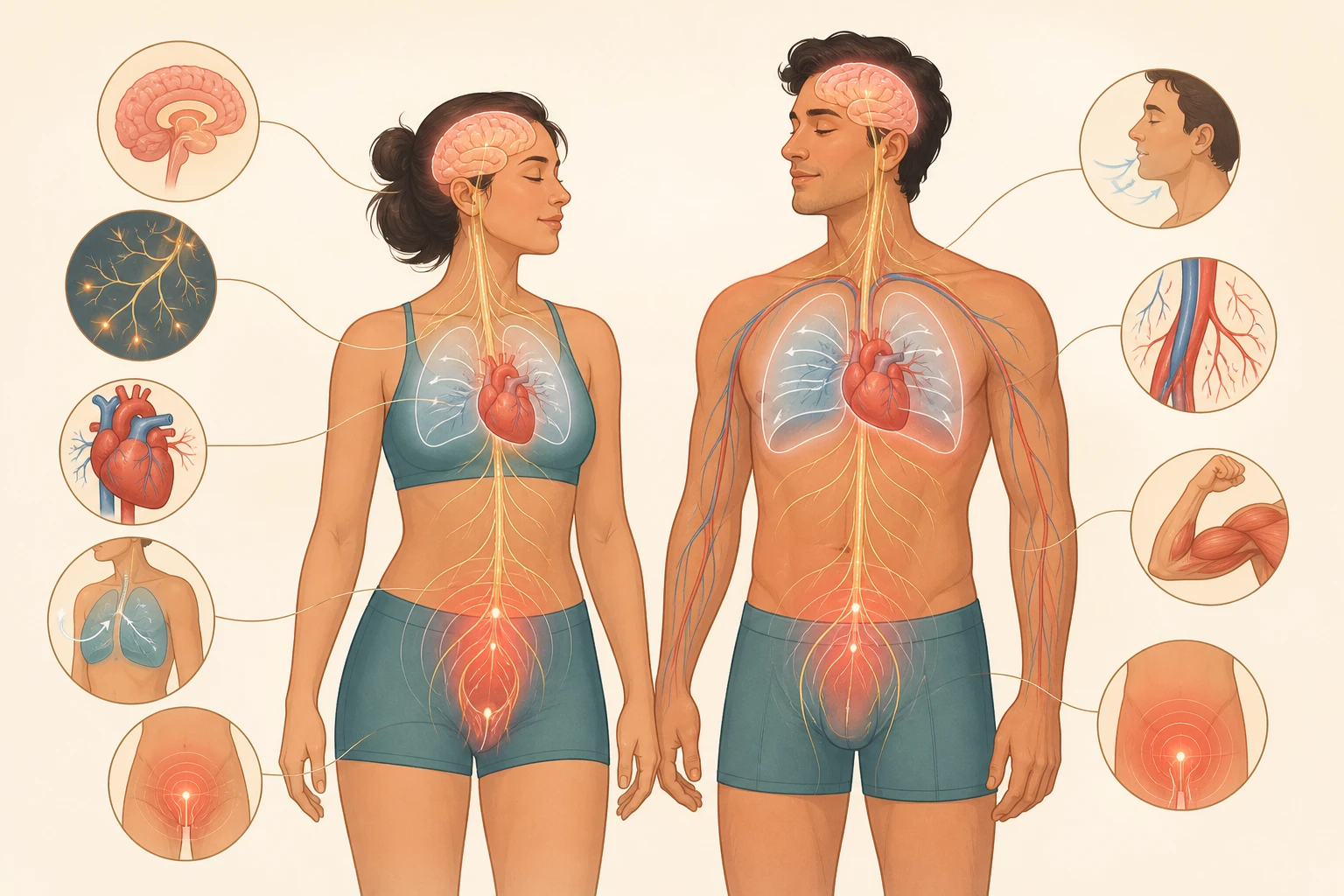
Sexual response starts in the brain and then involves nerves, hormones, and blood flow. Responses vary widely and are individual.
- increased blood flow in the genital area
- higher touch sensitivity
- faster heart rate and changes in breathing
- waves of muscle tension and release
What does the penis do during sex?
During sexual arousal, the penis may become firm because more blood flows into erectile tissue. That erection can make touch and penetration easier, but it is not a reaction that appears on command. It may happen quickly, more slowly, unevenly, or fade again. All of that can be completely normal. (MSD Manual)
What happens in the vulva, clitoris, and vagina?
During sexual arousal, the vulva and clitoris usually get more blood flow. That can make the area more sensitive, fuller, and more responsive to touch. For many people, the clitoris plays a central role in pleasure and orgasm, even though it is still left out of everyday sex education far too often.
The vagina may become wetter because the body produces fluid that can reduce friction and make touch or penetration feel more comfortable. It can also relax and expand as arousal builds. At the same time, the pelvic floor muscles may tighten and release. All of this can be part of a normal sexual response. (MSD Manual)
Important: arousal is never proof of consent. Consent is a conscious decision, not an automatic body reaction.
Why arousal may not happen
Stress, anxiety, uncertainty, pain, alcohol, tiredness, or performance pressure can affect body response. This is common and does not automatically mean lack of attraction.
Communication does not kill the mood
Good sex is rarely pure intuition. It is coordination: what feels good, what is too much, and what is wanted today. Talking usually makes sex easier, not harder.

A quick check-in often helps
A check-in does not have to be long. A glance, nod, or short question can be enough. The key is that both people know they can influence what happens at any time.
How does intercourse work?
In vaginal intercourse, the penis is inserted into the vagina. It often starts slowly so the body can adapt. Friction and movement can increase arousal and ejaculation may happen.
If sperm reaches the vagina during a fertile window, pregnancy can occur. A neutral overview is available from the NHS guide to getting pregnant. (MedlinePlus)
In short: there is no one correct intercourse script. Consent, pace, enough arousal, and protection matter most.
Important context
Intercourse is only one form of sex. It is not a mandatory step and not automatically the most important part of sexuality.
Myths and facts
- Myth: The body always goes through sex in the same order.
- Fact: Sexual response is individual and can vary a lot from one situation to the next.
- Myth: An erection or lubrication automatically proves desire or consent.
- Fact: Those are body responses. Consent is always a conscious decision.
- Myth: Orgasm is the real goal of sex.
- Fact: Orgasm can be enjoyable, but it is not the only sign of a good sexual experience.
- Myth: If penetration hurts, you just need to try harder.
- Fact: Recurring pain is a warning sign and should be taken seriously.
First time: what is actually normal?
At first, nervousness, uncertainty, and awkward moments are common. Many people do not have a perfect experience right away. Comparing yourself to movies or stories usually does not help, because real sex is often quieter, slower, and less predictable.
Helpful basics are slower pace, clear words, enough time, protection, and a realistic focus: not performance, but safety and respect. Stopping is always allowed. Does the first time hurt? What’s normal and what isn’t
If sex hurts or things do not go as expected: what helps?
Pain can have many causes, including tension, dryness, going too fast, fear, infection, or missing communication. First steps are usually slower pace, more pauses, enough arousal, possibly lubricant, and clearer agreements.
If pain keeps returning, becomes stronger, or comes with symptoms like fever, bleeding, foul-smelling discharge, or ongoing discomfort, medical evaluation is important.
When the main issue is psychological
Sometimes the core issue is less physical and more about stress, pressure, or difficult past experiences. That is real too. Counselling can help, especially if fear, avoidance, or boundary violations are involved.
Orgasm: possible, not required
Orgasm can be an intense part of sex, but it is not mandatory. Some people experience it quickly, others rarely, and some not at all. This can vary by situation, trust, stress level, and health.
Orgasm is not a quality score. Performance pressure often lowers relaxation. Less goal pressure can make desire easier to experience naturally.
Pornography vs reality
Porn is staged entertainment. It is edited and optimized for effect. Real sexuality includes conversation, uncertainty, pauses, and adjustments. That is normal and healthy.
If porn or other sexual media create pressure, it helps to reframe: real sex is cooperation, not a performance test. Understanding porn addiction: when porn and masturbation become a problem
Protection, birth control, and safer sex
Sex can lead to pregnancy and sexually transmitted infections. Condoms are a key baseline because they address both. You can find a reliable STI overview from the Government of Canada STI page. (WHO)
If a condom breaks or slips
If a condom breaks, slips, or is used too late, follow a calm plan: assess risk, consider cycle timing, and get advice quickly. A practical emergency contraception overview is available on the NHS emergency contraception page. (WHO)
Testing and support
If there are new partners, unclear risk situations, or symptoms, testing can be useful. Early clarification reduces uncertainty and supports appropriate treatment. (WHO)
Safer sex also means making a plan
Safer sex is not just a product. It is a shared plan: what contraception you use, how you handle condoms, and what you do if symptoms appear. Clear agreements reduce stress.
When should you get help?
- recurrent pain or strong fear related to sex
- pressure, overload, or violated boundaries
- uncertainty about contraception, STI risk, or emergency contraception
If something does not feel safe, that is enough reason to seek support from healthcare professionals or trusted counselling services.
Conclusion
Sex does not work through perfect technique. It works through consent, communication, and protection. When pace, boundaries, and safety are discussed together, sex becomes more realistic and respectful.
Related reading
More on having sex for the first time, consent, and protection.